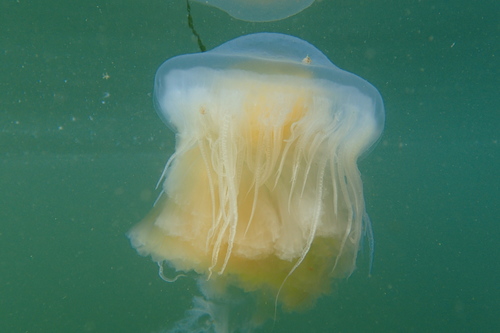
About Phacellophora camtschatica Brandt, 1835
Phacellophora camtschatica, commonly known as the fried egg jellyfish or egg-yolk jellyfish, is the only species in the monotypic family Phacellophoridae. It gets its common name from the yellow egg-yolk-like coloration in the center of its body that makes it easy to identify. Some individuals have a bell that can reach close to 60 cm (2 ft) in diameter, and most individuals have 16 clusters of up to a few dozen tentacles, each up to 6 m (20 ft) long. A smaller warm-water jellyfish found primarily in the Mediterranean Sea, Cotylorhiza tuberculata, is also commonly called a fried egg jellyfish. P. camtschatica is sometimes also confused with the lion's mane jellyfish (Cyanea capillata).
This jellyfish feeds primarily by collecting medusae and plankton with its tentacles to bring them to its mouth for digestion. Like most of its relatives in the phylum Cnidaria, its main food gathering strategy is suspension feeding. It can only produce limited motion, so it mostly drifts with the current, even when it actively swims. Its body has no respiratory, circulatory, or excretory systems, and instead uses its large surface area to carry out these functions. Like all cnidarians, this species lacks a mesoderm and uses mesoglea instead; it is therefore diploblastic, not triploblastic, and does not have three true tissue layers.
This is a cool water species that occurs in most of the world's oceans, and is most common in the Northern Pacific. Though the sole species in this genus has relatively low abundance in open marine waters overall, it can be quite abundant in parts of the Sea of Japan and the Sea of Okhotsk, particularly near shore, where it dominates southern portions of this area. Most individuals are found alone, but the species also occurs in the western and eastern Bering Sea, and makes up a noticeable proportion of jellyfish biomass in waters of the northern California Current. A 2011 study found that this jellyfish mostly aggregates over deep basins; a significant number of individuals are only found in shallow areas off West Kamchatka. This habitat preference contrasts with that of members of Ulmaridae (where this species was previously classified), which prefer shallow water. The preference for deeper water may be linked to the species' bell size, which ranges from 5 to 59 cm; this size likely allows the jellyfish to resist stronger currents and pressure to swim in deeper waters. Like other jellyfish, egg-yolk jelly populations are growing in degraded ecosystems, due to their increased tolerance to harmful conditions. Jellyfish have an important role in marine food webs and can act as indicators of ecosystem structure and function; larger jellyfish populations have greater negative impacts on ecosystem services.
Egg-yolk jellyfish typically move faster during the day, and swim fastest during flood tides. They perform vertical migrations across the water column over both short and long time frames, which allow them to enter the low depths of hypoxia zones. This genus typically lives below the pycnocline and avoids crossing the boundary layer, but often dives into the hypoxic layer during the day when competition is high. Diving into the hypoxia zone allows this jellyfish to evade competition. Unlike most species, which leave oxygen-depleted hypoxic areas, the fried egg jellyfish can tolerate low oxygen levels for several hours at a time. Because hypoxia regions are expected to continue growing, this species may thrive as a result.
The reproduction and life cycle of this jellyfish is well documented, as it is kept in culture at the Monterey Bay Aquarium. It follows the typical life cycle of other members of the class Scyphozoa, alternating between two forms: an asexually reproducing polyp form and a sexually reproducing medusa form. The life cycle starts when eggs are fertilized, and develop into ciliated planulae. These planulae swim for roughly 3 to 5 days before settling by attaching to the seabed and metamorphosing into the polyp (scyphistomae) stage. As the polyp develops, it progresses through stages with 2, 4, 8, and 16 tentacles, with each stage differing in overall calyx shape and tentacle symmetry. When the polyp is mature, it has between 30 and 44 tentacles, and asexual reproduction occurs through side budding (one bud per polyp) and strobilation. During strobilation, the polyp lengthens and thins, while its tentacles shorten and thicken, then mature ephyrae are released. Newly released ephyrae have a cruciform mouth with nematocyst batteries scattered across their body. As ephyrae mature, tentacles elongate and become filiform, medusae grow larger bell diameters, additional tentacles form, oral arms elongate, and the gastric system develops in a centrifugal direction. Under laboratory conditions, sexual maturity is reached after approximately 9 months, after which sexual reproduction occurs in the water column and the full cycle repeats.

