About Phacellodomus rufifrons (Wied-Neuwied, 1821)
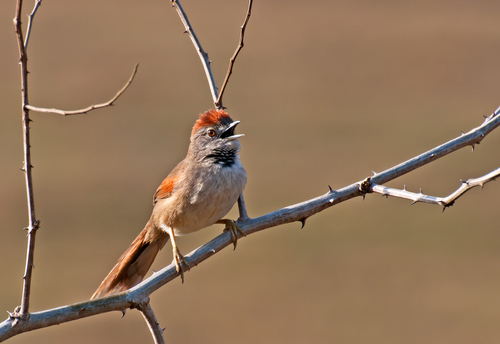
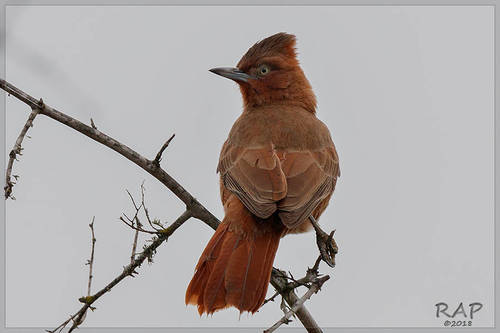
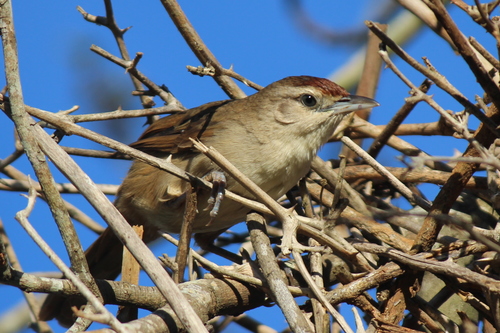
The rufous-fronted thornbird, scientifically Phacellodomus rufifrons (Wied-Neuwied, 1821), measures 16 to 17 cm (6.3 to 6.7 in) in length and weighs approximately 18 to 31 g (0.63 to 1.1 oz). Males and females have identical plumage. Adults of the nominate subspecies P. r. rufifrons have a dull buff supercilium that extends past the eye, a dark brown stripe behind the eye, and dark grayish lores on an otherwise pale buff-brown face. Their forehead (called the "front") is dark rufous, and their crown is dark brownish with faint paler streaks. Their upperparts are a slightly lighter shade of dark brown. Their wings are mostly dull brown, with darker brown primary coverts. Their tail is dull brown. Most of their underparts are brownish white, with darker brownish sides, richer brownish flanks, and pale undertail coverts with a faint rufescent tinge. Their iris ranges from brown to grayish white, their maxilla is blackish to dark gray, their mandible is gray to blue-gray, and their legs and feet are gray. Juveniles lack the characteristic rufous forehead, and their underparts are mottled. Subspecies P. r. sincipitalis is similar to the nominate, but has slightly brighter, more rufescent upperparts and flanks, and slightly more rufous flight feathers. P. r. peruvianus has more, but paler, rufous on the forehead than the nominate, and brighter, more fulvous flanks. P. r. specularis has more and deeper rufous on the forehead than the nominate, plus a moderately sized rufous patch on the flight feathers and rufescent outer tail feathers. The rufous-fronted thornbird has a disjunct distribution, with subspecies occupying separate ranges as follows: P. r. peruvianus is found in the upper Marañón River watershed, in extreme southern Ecuador's Zamora-Chinchipe Province and the northern Peruvian departments of Amazonas, Cajamarca, and San Martín. P. r. specularis is found in Pernambuco state in northeastern Brazil. P. r. rufifrons is found in eastern Brazil, from Maranhão south to São Paulo state. P. r. sincipitalis is found in eastern Bolivia, the Brazilian states of Mato Grosso and Mato Grosso do Sul, north-central Paraguay, and northwestern Argentina as far south as Tucumán Province. The rufous-fronted thornbird lives in a range of landscapes that all share two common features: dense thickets and at least some trees. These landscapes include lowland and montane arid scrublands, tropical deciduous forest, gallery forest, secondary forest, cerrado, and savannah. In Brazil, the species mostly occurs below 1,300 m (4,300 ft); in other parts of its range, it occurs locally at elevations as high as 2,000 m (6,600 ft).