About Phacelia sericea (Graham) A.Gray
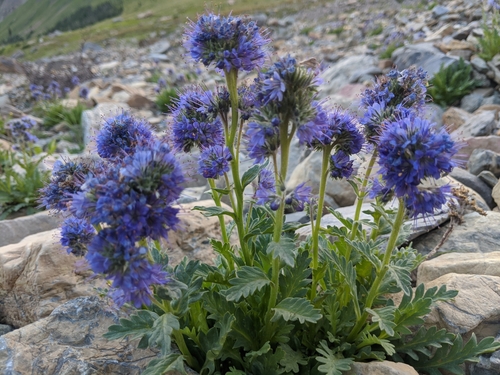
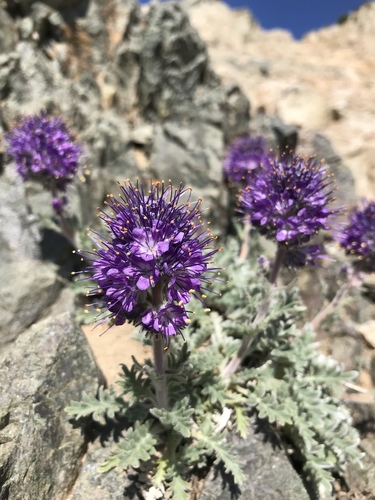
Phacelia sericea (Graham) A.Gray grows from a tap-rooted, branched woody base, and produces several upright or ascending stems that reach up to 0.6 metres (2 ft 0 in) in height. Its leaves are pinnatifid, with either cleft or entire segments. Basal leaves are somewhat larger than the upper cauline leaves, are more persistent, and have petioles. Both leaves and stems are generally covered in silvery silky hairs, and are barely glandular. The inflorescence is made up of multiple short, tightly packed panicles at the tip of the stem, and has an appearance similar to a bottle-brush. The dark blue to purple, bell-shaped corolla measures 4–6 millimetres (0.16–0.24 in) across. It is hairy on both the inner and outer surfaces, but is not glandular. The filaments are two to three times as long as the corolla, which gives the inflorescence a fuzzy look. The anthers are bright yellow or orange, and the style is shortly cleft. The fruit is a two-chambered capsule that contains 8 to 18 seeds. Phacelia sericea is a subalpine to alpine species that grows on open, well-drained slopes, usually at elevations above 1,500 metres (4,900 ft). Its documented range includes the mountains of Vancouver Island, the southern British Columbia Pacific Ranges, the Rocky Mountains from Banff National Park to southern Colorado, Olympic National Park, the Cascade Range of Washington, the mountains of eastern Oregon, the northernmost counties of California, and the mountains of Idaho, Nevada and Utah. It typically blooms from the end of May through the end of August. The Federal Highway Administration lists Phacelia sericea as a native species suitable for roadside landscaping in Colorado. This plant should be handled with care, because its long flower hairs have been reported to cause skin irritation.