About Phacelia argentea A.Nelson & J.F.Macbr.
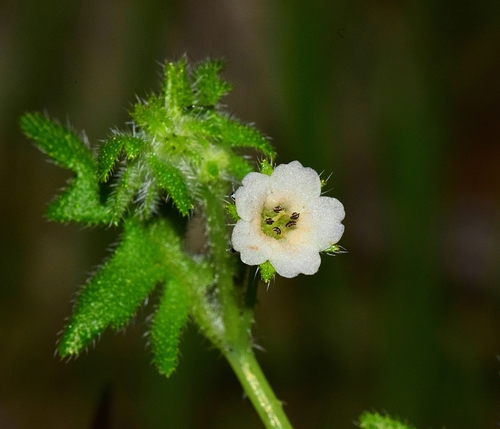
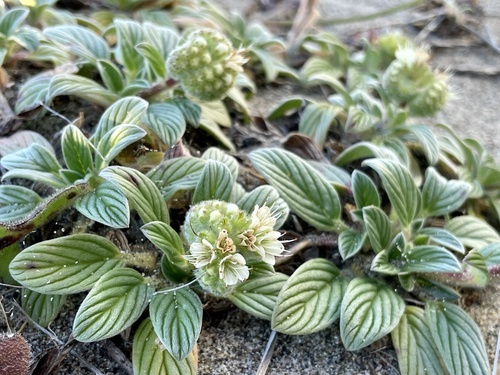
Phacelia argentea A.Nelson & J.F.Macbr. is a rare phacelia species, commonly called sand dune phacelia or silvery phacelia. It is native to the coastline of southwestern Oregon and far northwestern California; a 1995 survey counted a total of 33 separate sites for this species. It is the only phacelia species that is endemic to coastal sand dune habitat, an ecosystem that has been altered and is declining in this region. This plant is a hairy, fleshy perennial herb. It can grow in a prostrate form or grow upright, reaching a maximum length of close to 45 centimeters. Its leaves are thick, covered in long, straight, silvery hairs, roughly oval in shape, with either pointed or rounded tips, and can grow up to 12 centimeters long. The inflorescence is made up of a cluster of one-sided coiling cymes, which hold many bell-shaped flowers. Each flower is roughly half a centimeter long, and is white or cream-colored, with whiskery protruding stamens. This species' flowers are pollinated by honey bees, bumble bees, and a local native leafcutter bee called Anthidium palliventre. The main threat to this rare species is the introduced non-native European beachgrass, Ammophila arenaria. This grass was originally planted to stabilize the sand dunes, and it now dominates the habitat, endangering Phacelia argentea.