About Pezopetes capitalis Cabanis, 1861
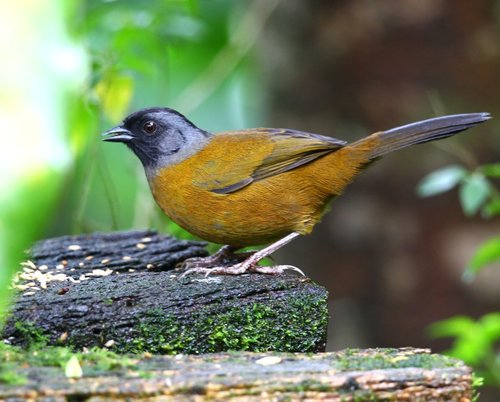
The large-footed finch, scientifically named Pezopetes capitalis Cabanis, 1861, is a passerine bird that is endemic to the highlands of Costa Rica and western Panama. Despite its common name, it is not a true finch. Instead, it belongs to the large family Passerellidae, a group that also includes American sparrows, juncos, and towhees. It is the only species in the monotypic genus Pezopetes. This bird is common in the undergrowth of mountain forests, second growth, bamboo clumps, and scrubby pastures, ranging in altitude from 2150 m up to scrubby páramo at 3350 m. It is easily observed in preferred sites such as Cerro de la Muerte. The female large-footed finch builds the nest, which is a large, loose cup constructed from plant material. Nests are placed less than 2 meters above ground in bamboo or a dense shrub. The typical clutch contains one or two brown-marked white or blue-white eggs. Only the female incubates the eggs, which hatch after 12 to 14 days of incubation. The large-footed finch is a large, robust terrestrial species. It measures 20 cm (7.9 in) in length and weighs 56 g (2.0 oz). It has a slender bill, a moderately sized tail, and very large, powerful feet and legs. This species is one of the heaviest members of its diverse family. Adult large-footed finches have a slate grey head, which turns black on the throat, forehead, and sides of the crown. Their upperparts are dark olive, while their wings and tail are black with olive fringes. Their underparts are bright olive, with a brown tint on the flanks and lower belly. Juvenile large-footed finches have a streaked dark olive head, blackish scaling on the upperparts, and buff-olive underparts. This species produces a thin seet call. The male's song, delivered from the ground or a low perch, is a mixture of whistles, warbles, chatter, and mimicry. The large-footed finch feeds on insects, spiders, and seeds, which it extracts from leaf litter using powerful double scratches that can throw debris up to 30 cm away. It will also pick berries from low bushes. It is normally encountered in pairs.