About Peucetia rubrolineata Keyserling, 1877
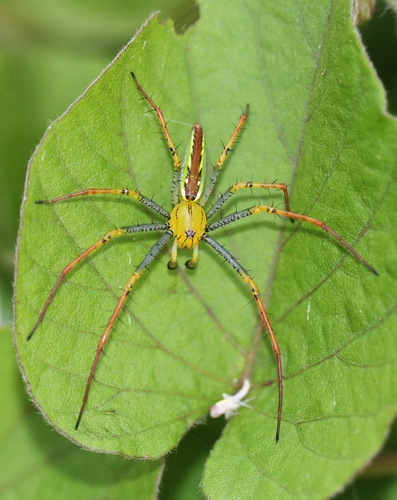
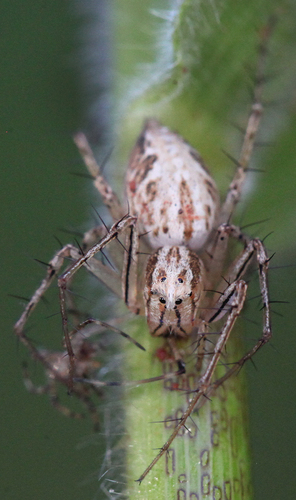
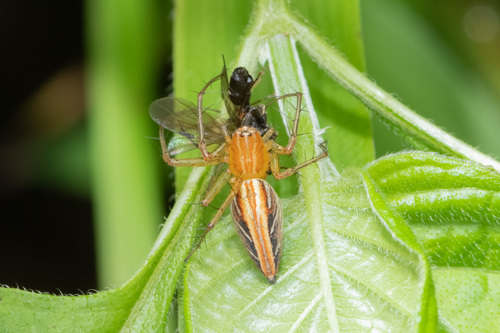
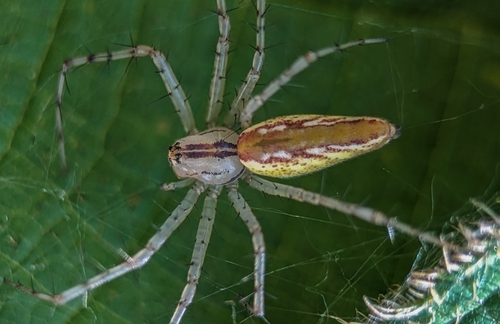
Peucetia rubrolineata Keyserling, 1877 exhibits noticeable sexual size dimorphism: males have a total body length between 5.71 and 10.28 mm, while females range in total length from 2.85 to 13.28 mm. For both sexes, the carapace is orange. It bears a red thoracic groove and variable red longitudinal bands. In live or freshly collected specimens, the carapace has two median red longitudinal bands that vary in width, and these bands sometimes cover almost the entire surface of the carapace. The clypeus and chelicerae are orange. Chelicerae have two lateral red bands and a single black spot on the cheliceral boss. Males have cream-colored legs, with darker metatarsus and tarsus segments, and dark spots at the base of leg spines. The male abdomen is gray on the dorsal side, with lateral white bands, and gray on the ventral side, with white spots located near the epigastric furrow and spinnerets. The male palpal structure is distinctive: it includes a bifid paracymbium with simple branches, and a median apophysis with a curved, bifid apical projection. Females have more variable coloration than males. Their carapace is orange, marked with red margins and red longitudinal lines. The female sternum is green with orange margins. Female legs are orange, with black spots at the base of spines, and red spots at the base of ventral femoral spines. The female abdomen is white with a gray folium on the dorsal side, and a central gray band on the ventral side. The female epigynum is concave, with distinct longitudinal and transverse septa. This species has a broad Neotropical distribution, ranging from Panama through most of South America to Argentina. It has been recorded from multiple countries, including Brazil, where many of the species’ type specimens were originally held at the Museu Nacional before the devastating 2018 fire at the institution. In Chile, Peucetia rubrolineata is restricted to the country’s extreme northern regions.