About Peucedramus taeniatus (Du Bus de Gisignies, 1847)
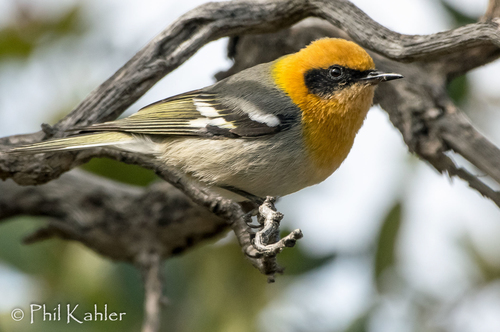
The olive warbler, scientific name Peucedramus taeniatus (Du Bus de Gisignies, 1847), is a medium-sized warbler. Adults measure 13 to 14 cm (5.1–5.5 in) in length and weigh 9.5 to 12 g (0.34–0.42 oz). This species follows Bergmann's rule, showing clinal size variation where more northern populations are larger than southern ones. It is a long-winged bird. Breeding males have a mostly grey body, with olive-green coloration on the wings and two distinct white wing bars. Males have tawny-orange coloring on the head and breast, along with a black patch that extends through the eye. Females and juveniles have yellow in place of the male's orange, and their dark eye mask is much more diffuse. Along with size differences, plumage also varies geographically: southern populations have more brightly colored plumage than northern ones. The olive warbler's song is made up of clear whistles, commonly rendered as phrases like hirrJI hirrJI hirrJI or plida plida plida chir chir. Males sing throughout the year. Singing frequency increases in late winter and peaks in early spring. For most of the year, males sing the most during midmorning, but during spring they sing constantly during mornings and late afternoons. Males almost always deliver their song from the canopy of tall trees or other elevated tall tree perches. This species is distributed from the southwestern United States south to Nicaragua, and its family is the only bird family endemic to North America. Across the northern portion of its range, its distribution is continuous, running from Yavapai County, Arizona and the southwestern tip of New Mexico through central Mexico to southern Mexico. The rest of its range has a disjunct distribution, with separate populations in the Mexican states of Tamaulipas, Coahuila, Sonora, and Chihuahua, further south in southwestern Guatemala, and from northern El Salvador and central Honduras to northern Nicaragua. The olive warbler inhabits mountains and highlands. In the northern part of its range, it occurs at 2,600 m (8,500 ft) above sea level or higher, and in some regions it is not found below 3,500 m (11,500 ft). In Oaxaca, Mexico, it occupies elevations between 1,700–3,000 m (5,600–9,800 ft). Further south in Guatemala, it can be found as low as 1,850 m (6,070 ft). At the southern end of its range in Honduras, it occurs as low as 1,000 m (3,300 ft), and in Nicaragua it lives in a forest belt between 1,070–1,370 m (3,510–4,490 ft). It typically lives in conifer forests, including ponderosa and sugar pine forests in Arizona, Abies common fir forests, and mixed oak and pine forests across central Mexico, Guatemala, and Honduras. These forests can range from humid to semi-arid. In coastal regions, the olive warbler may use stands of palms, and in the Valley of Mexico it inhabits pine and alder forests. Over most of its range, the olive warbler is a resident species. However, evidence indicates that the northernmost populations are partial migrants. Birds from Arizona, New Mexico, and northern Mexico appear to leave their breeding grounds, though the exact details of their movements are not clear. It has been proposed that they are either downslope migrants moving to lower elevations, or dispersive; this is supported by recorded sightings of the species in Texas. Individuals of the northern subspecies P. t. arizonae have also been recorded near Tepic, Nayarit. Even so, some individual birds remain in the northern portion of the species' range year-round.

