About Peucedanum officinale L.
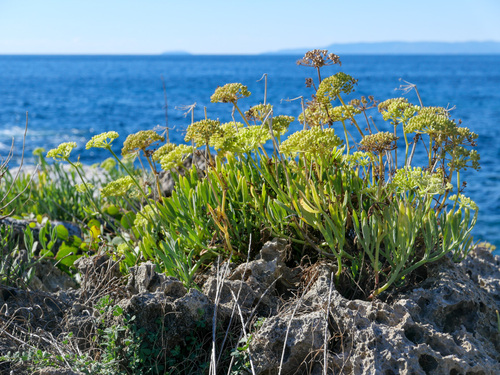
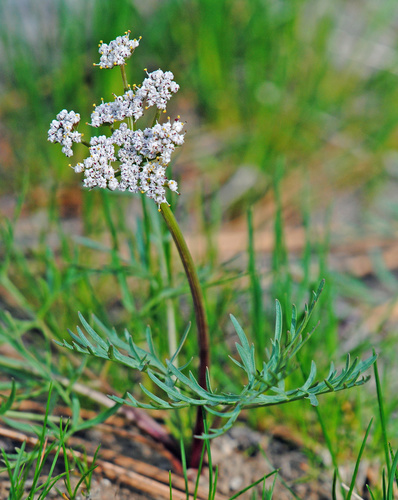
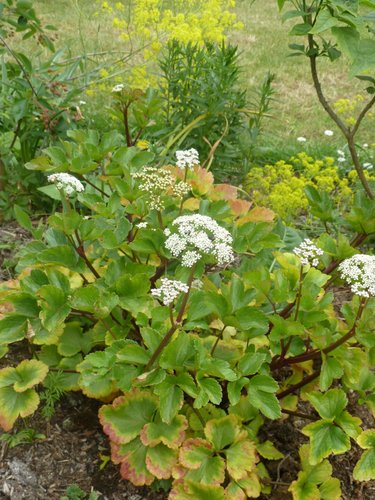
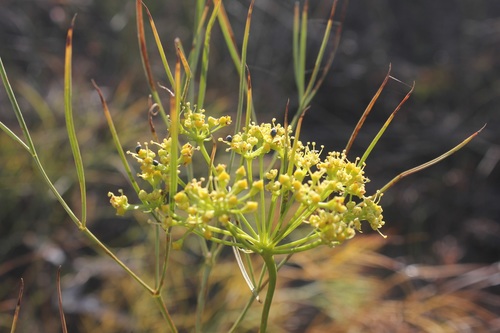
Peucedanum officinale L. is a glabrous herbaceous perennial plant in the Apiaceae family. It grows mainly across Central and Southern Europe, and is also native to the United Kingdom, where it holds the common names hog's fennel and sulphurweed. In the UK it is a rare species, found only in specific localities in the counties of Essex and Kent. It was previously recorded near the town of Shoreham-by-Sea in West Sussex, but it has been extinct at that site for a long time. Its typical habitat includes rough grassland, clayey banks, and sea cliffs. This perennial grows from a stout rootstock, with stems reaching up to 2 meters tall; the stems are solid, striate, sometimes weakly angled, sparsely marked with wine-red blotches, and surrounded by fibrous remains of old petioles at the base. Its bushy, spreading clump of dark green long-petioled leaves bears linear, sessile lobes that taper to a point at both ends and have narrow cartilaginous margins, so individual lobes resemble grass blades. These leaves contrast with the plant's umbels of greenish-yellow flowers. It has been recognized as a medicinal plant in Britain since at least the 17th century, and is included in the herbals of both Nicholas Culpeper and John Gerard. In Culpeper's time it was more abundant than it is today; Culpeper recorded it growing plentifully on Faversham marshes, and also noted additional common names for the species: hoar strange, hoar strong, brimstonewort, and sulphurwort. The name hoar strong is comparable to the German word Haarstrang, meaning hog's tail. The plant produces a long stout taproot, described by Gerard as black on the outside, white on the inside, and sometimes as large as a man's thigh. When the taproot is cut in spring, it releases a large amount of yellowish-green latex. This latex dries into a gummy oleoresin that retains the strong, sulphurous scent of the root. This harvesting method and the resulting product are very similar to those used for two other medicinal umbellifers: Ferula assa-foetida and Dorema ammoniacum. A decoction made from the root of Peucedanum officinale acts as a diuretic, sudorific, and antiscorbutic, and controls menstruation. Gummi Peucedani, the oleoresin produced by drying the root latex, has properties similar to those of Gum Ammoniac, the oleoresin obtained from Dorema ammoniacum. This species has also been used in veterinary medicine.