About Peucedanum japonicum Thunb.
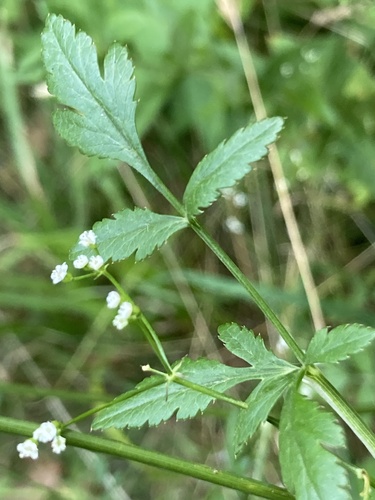
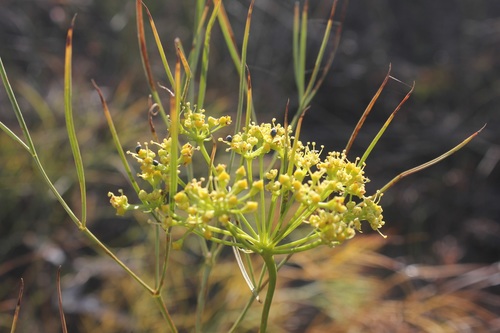
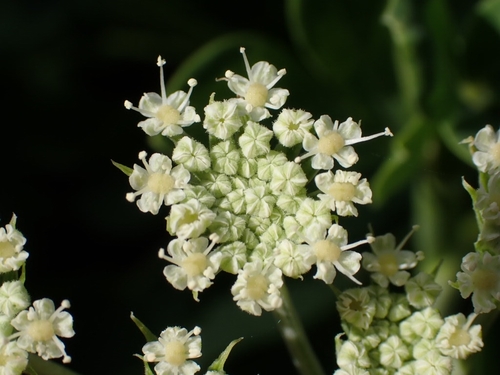
Peucedanum japonicum Thunb. is a stout umbellifer that grows 30–100 cm tall, and is essentially glabrous. Its stem is frequently flexuous. The leaf blade is broadly ovate-triangular, measuring 35 cm by 25 cm. It is thinly coriaceous, and bears 1-2 ternate leaflets, which are ovate-orbicular, 3-parted, 7–9 cm broad, and glaucous. Its central leaflet segments are obovate-cuneate, while its lateral segments are oblique-ovate. Umbels measure 4–10 cm across; there are either 2-3 bracts, or bracts are absent, and when present bracts are ovate-lanceolate, 5-10 mm long by roughly 2 mm wide, and pubescent. This species produces 15-30 unequal, puberulous rays that measure 1–5 cm long. It has 8-10 linear-lanceolate bracteoles, which equal or exceed the length of the flowers. Its umbellules hold approximately 20 flowers each. Calyx teeth are obsolete. Petals are purple or white, and are abaxially hispidulous. Styles are short. The fruit is oblong-ovate or ellipsoid, reaching up to 6 mm long by 4 mm wide. It is hirsute, especially along its dorsal ribs; its lateral ribs have very thick wings. Its vittae are small, with 3-5 vittae in each furrow, and 6-10 vittae on the commissure. This species flowers from June to July, and fruits from August to September. It grows in coastal areas and seashores below 100 meters in elevation, typically in soil that ranges from slightly acidic to mildly alkaline. P. japonicum is distributed in the Chinese provinces and regions of Fujian, Hong Kong, Jiangsu, Shandong, Taiwan, and Zhejiang, as well as in Japan, Korea, and the Philippines.