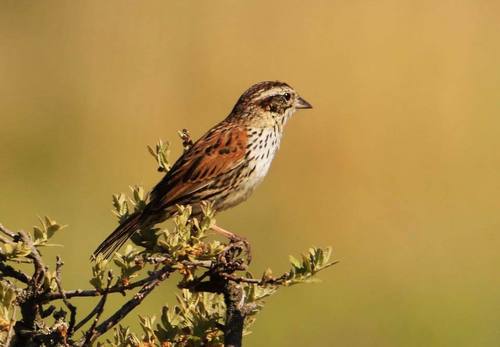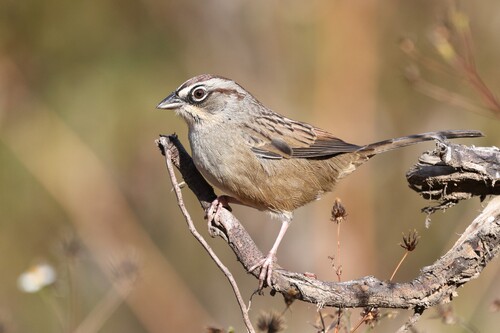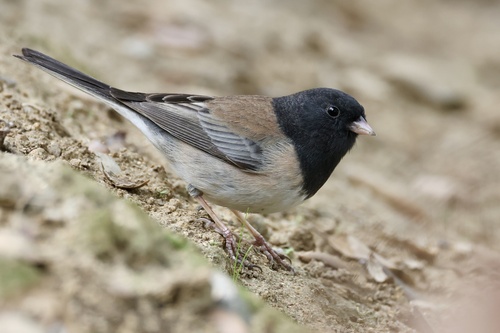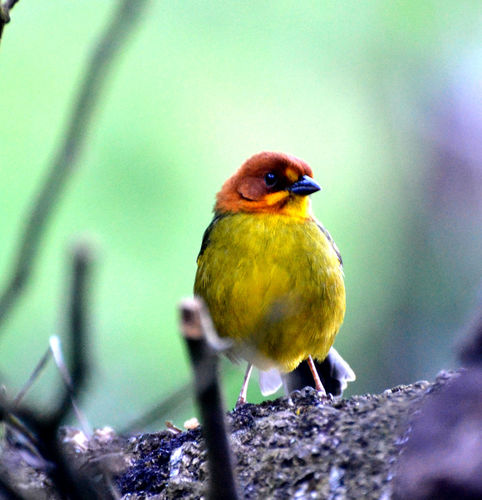
About Peucaea aestivalis (M.H.K.Lichtenstein, 1823)
Peucaea aestivalis, commonly known as Bachman's sparrow, has well-documented habitat preferences that consistently point to selection of a dense herbaceous vegetation layer below 0.9 m (3 feet). Across study sites in Arkansas, Alabama, Florida, South Carolina, and North Carolina, percent ground cover and percent grass cover are consistently higher (over 58%) on sites occupied by Bachman's sparrows compared to unoccupied sites. In 17- to 28-year-old slash pine plantations in northwestern Florida that had been burned within 4 years, Bachman's sparrow abundance was significantly correlated (r=0.46, p=0.043) with relative grass volume. In age-varying, differently managed longleaf and loblolly pine stands in South Carolina, areas occupied by Bachman's sparrows always had high vegetation volumes at or below 1 m (3 feet) above ground. In red-cockaded woodpecker (Picoides borealis)-managed longleaf pine woodlands in Florida, occupied sites had significantly higher vegetation densities at or below 0.5 m (2 feet) (p=0.007) than unoccupied study sites, and grass density (primarily bluestems of genera Andropogon and Schizachyrium) at or below 0.5 m was also significantly greater on occupied sites (p=0.004). In Mississippi, Bachman's sparrows were significantly more abundant (p≤0.01) in mixed pine-grassland restoration stands, which had greater understory, grass, and forb cover, than in traditionally managed stands. In 1- to 6-year-old loblolly pine stands in eastern Texas, herbaceous ground cover was significantly greater in study areas occupied by the species (p=0.003). In south-central Missouri, glades occupied by Bachman's sparrows had significantly more grass cover (p=0.03) and forb cover (p=0.0005) than unoccupied glades. However, in Arkansas loblolly and shortleaf pine plantations, vegetation densities below 0.9 m and percent ground/grass cover did not differ significantly (p>0.05) between occupied and unoccupied areas. While much research emphasizes grasses and herbaceous vegetation under 0.9 m, recent studies show that Bachman's sparrows respond to grass density with a threshold effect, and actually decline in areas where grass is too dense. This is likely because Bachman's sparrows typically walk across the ground instead of flying, so extremely dense grass can block their movement. Additionally, even though the species selects home ranges with relatively low woody vegetation density, individual birds tend to choose microhabitats within their home ranges that have higher woody vegetation density. This is possibly because woody vegetation provides important song perches for males, as well as escape cover. Vegetation patchiness and ground layer species composition can affect habitat suitability by altering foraging success, and the availability of food and nesting material. In Georgia, Bachman's sparrows were absent from open areas with uniformly dense herbaceous vegetation, even though these sites had the same volume of vegetation at or below 1 m above ground as recently burned, occupied pineland sites. In eastern Texas clearcuts, untaken measurements suggest the species may favor clumpy rather than uniformly distributed tall grass. In Arkansas loblolly and shortleaf pine plantations, the lack of observed ground layer effects on breeding territory selection is explained by unmeasured habitat characteristics, such as herbaceous layer patchiness and species composition. In a mostly longleaf pine forest in Georgia, Bachman's sparrows were significantly more abundant (p=0.04) in areas where ground cover was primarily Beyrich threeawn (Aristida beyrichiana), compared to relatively disturbed communities dominated by bluestems (Andropogon spp.) and silkgrass (Pityopsis spp.). The amount of litter and debris on a site can also influence Bachman's sparrow habitat selection. Across Arkansas, Alabama, Florida, South Carolina, and North Carolina, percent litter cover was consistently over 58% on occupied sites. In a South Carolina loblolly pine forest, although statistical significance was not tested due to small sample size, Bachman's sparrows occurred at higher densities in control plots (1.5 territories/40 ha) than in plots where downed coarse woody debris over 10 cm (4 inches) in diameter had been removed (0.4 territories/40 ha). Haggerty suggests that litter may provide habitat for the prey of Bachman's sparrows, but that too much litter could interfere with foraging. In Arkansas loblolly and shortleaf pine plantations, both litter cover (78%) and litter depth (1.2 cm/0.5 inches) on occupied sites were significantly lower (p≤0.01) than litter cover (88.9%) and depth (4.2 cm/1.6 inches) on unoccupied sites. Bachman's sparrows inhabit areas with open overstories. In eastern Texas sites with varying times since clearcutting, occupied study areas had significantly fewer short (≤3 m/10 feet) and tall (>3 m/10 feet) trees than unoccupied study areas (p<0.01). In age-varying, differently managed longleaf and loblolly pine stands in South Carolina, occupied plots always had lower volumes of vegetation between 2 and 4 m (7 to 13 feet) above ground compared to unoccupied sites. In middle-aged and mature Georgia forests dominated primarily by loblolly pine, Bachman's sparrow densities were negatively associated with combined tree/shrub volume and vegetation volume from 3 to less than 5 m (7 to less than 16 feet). In Arkansas loblolly and shortleaf pine plantations, Bachman's sparrow breeding areas had significantly lower percent canopy cover (p<0.001), shorter woody vegetation (p≤0.01), and fewer trees (p<0.001) and shrubs (p≤0.05) than unoccupied sites. In south-central Missouri, the species occurs in glades with less than 30% woody cover, and occupied glades had significantly lower percentages of deciduous and coniferous saplings, deciduous and coniferous trees, and total woody vegetation (p≤0.05). In northwestern Florida longleaf pine woodlands, mid-story density was marginally greater (p=0.055) on unoccupied sites, and Bachman's sparrow abundance was significantly negatively correlated (r= –0.446, p=0.043) with mid-story density. However, relative abundance of the species was not significantly associated with canopy cover (p=0.107), and there were no significant differences in canopy cover between occupied and unoccupied sites (p=0.133). There is evidence that Bachman's sparrows may select sites that have some tall vegetation. In north-central Florida, the density of Bachman's sparrows in young (2–4 year old) slash pine plantations with added artificial snags (n=3) was 31.4 pairs/km², while in similar vegetation without snags (n=3) density was 22.3 pairs/km². In a South Carolina area with longleaf and loblolly pine, Bachman's sparrows occurred at significantly higher density (p=0.002) in clearcuts than in middle-aged (22–50 year old) stands, but another area's clearcuts had relatively low densities of the species. Vegetation differences between the two sites likely explain this difference: the low-density site had been rolled with a drum chopper, resulting in lower vegetation volume between 1 and 2 m (3 to 7 feet) above ground. Authors suggest that the lack of vegetation in this height range may have limited available perches, leading to fewer birds at the site. A study of habitat characteristics in 1- to 6-year-old loblolly pine stands in eastern Texas recommended leaving 2 to 5 tall (>12 m/39 feet) trees per 100 ha on clearcuts to provide singing perches for Bachman's sparrows. In Georgia, the lack of vegetation between 3 and less than 5 m (10 to less than 16 feet) was suggested as a possible reason for the species' absence from open field vegetation. However, across the southeastern United States, vegetation density between 0.91 and 1.8 m (3 to 6 feet) above ground varies widely on occupied sites, indicating the species' requirements for this vegetation layer are comparatively flexible. In central Florida's dry prairie, Bachman's sparrows used clumps of saw-palmetto with "natural" burrows significantly more often than expected based on availability (p<0.001), and authors suggest the sparrows use these burrows as refuges from predators in prairie habitats. Bachman's sparrows occur primarily in the southeastern United States, ranging from central peninsular Florida north to southeastern North Carolina, and west through parts of Tennessee, Kentucky, and Missouri to eastern Oklahoma and eastern Texas. After forest conversion and the spread of agricultural fields through the early 1900s, the species rapidly expanded its range and began breeding in Illinois, Indiana, Ohio, West Virginia, Virginia, Maryland, and parts of Pennsylvania. This trend reversed during the 1930s, as much of the eastern deciduous forest recovered. Bachman's sparrows are thought to have been extirpated from Virginia in the early 2000s, and North Carolina now forms the northern periphery of the species' eastern range. Of the three recognized subspecies, Peucaea aestivalis aestivalis breeds furthest east, ranging from southeastern South Carolina to peninsular Florida. Peucaea aestivalis bachmanii occurs west of P. a. aestivalis, extending to Mississippi and north to Kentucky. Peucaea aestivalis illinoensis occurs in the westernmost portion of the species' range. Preferred habitat for Bachman's sparrows includes areas with a dense ground vegetation layer, open mid-stories, and scattered shrubs and saplings. This includes young clearcuts and open pine (Pinus spp.) forests. Bachman's sparrows forage on the ground for plant seeds and arthropods. In a mostly loblolly and shortleaf pine habitat in eastern Texas, all observed foraging by Bachman's sparrows occurred on the ground, and a literature review notes that the species rarely forages in shrubs. Reviews and an investigation of Bachman's sparrow diet in eastern Texas summarize the food items that make up the species' diet. The sparrows eat a variety of grass seeds including panicgrasses, bristlegrasses (Setaria sp.), crowngrasses (Paspalum spp.), and threeawns, as well as seeds from several other taxa including blueberries (Vaccinium spp.), pines, and sedges (Carex spp.). Arthropods in the species' diet include grasshoppers and crickets (order Orthoptera), spiders (order Araneae), beetles (order Coleoptera), caterpillars (order Lepidoptera), wasps (order Hymenoptera), and leafhoppers (family Cicadellidae). Insects make up a larger portion of the Bachman's sparrow diet in spring and fall than in winter. Stomach contents collected in eastern Texas (5 from summer, 11 from fall, 4 from winter) showed a greater abundance of insects in summer and fall than in winter.