About Petrosedum sediforme (Jacq.) Grulich
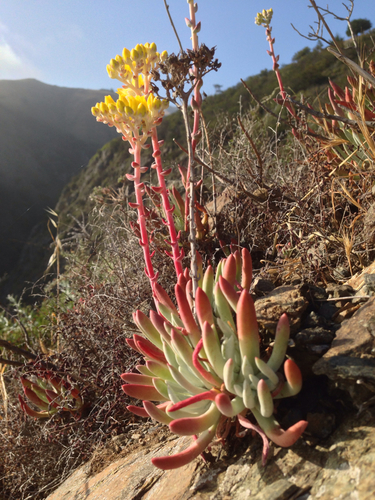
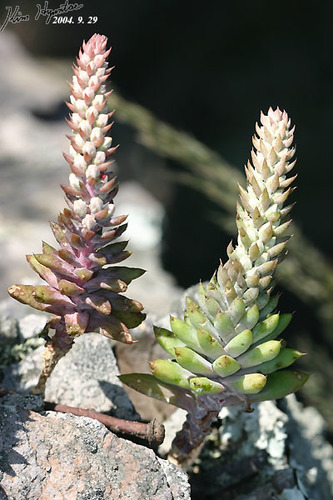
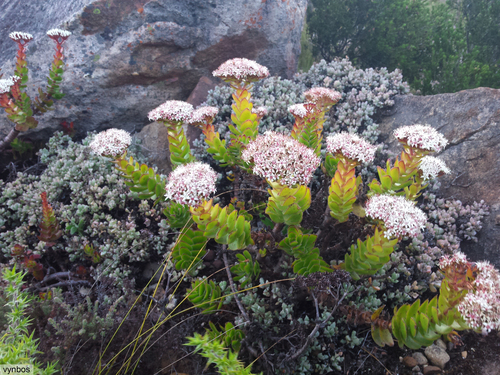
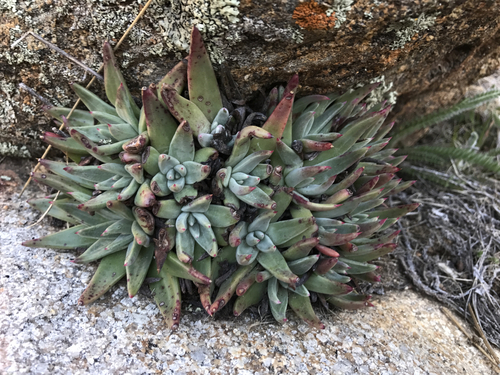
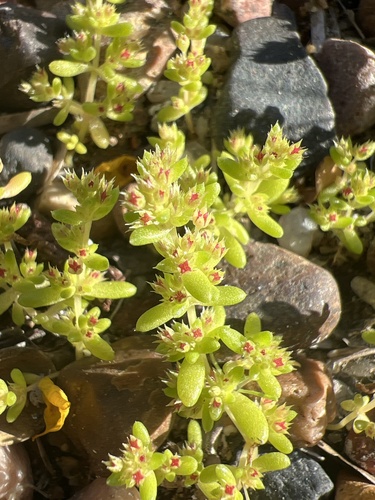
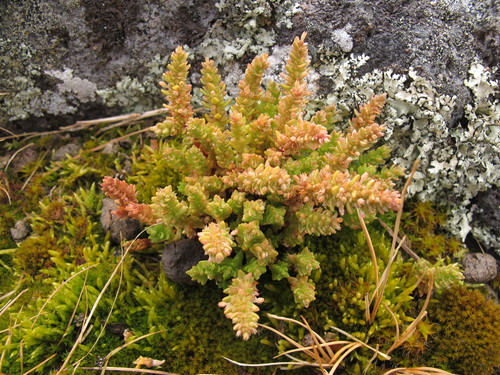
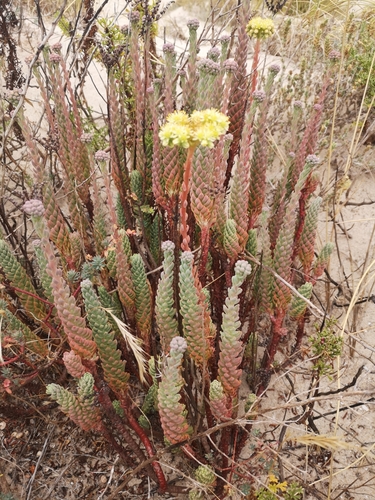
Petrosedum sediforme (Jacq.) Grulich is a branching succulent species, with often woody, non-flowering basal shoots. Its overlapping leaves are oblong to elliptic with pointed tips, somewhat thickened, and sometimes flattened and spurred. Leaves reach up to 20 mm in length, are smooth, dark green, and often glaucous. Because its leaves are remarkably succulent, the species does not enter summer dormancy. When blooming, it produces upright flowering stems that grow 25 to 60 cm tall. Flowers grow in clusters at the top of the stem, and each flower is attached by a very short stalk or no stalk at all. The small green triangular sepals, the outer parts that protect the flower bud, are about 2–3 mm long. The petals are oblong, greenish-white to creamy in color, and about 5–8 mm long. Flowers usually have 6–8 petals, and rarely 5 or 9. The stamens, the pollen-holding parts, have white filaments that are rough-textured at the base and yellow anthers. Flowers are produced in mid-summer, and are followed by erect, dark brown fruit. The seeds are oblong, brown, and ribbed. Petrosedum sediforme is difficult to distinguish from P. rupestre, P. ochroleucum, and P. montanum using only vegetative traits. Spanish plants with brownish or olive-green tones are very similar to some Israeli specimens, despite coming from opposite ends of the species’ range. In the Sierra Nevada, even plants growing side by side can show striking differences. The natural range of Petrosedum sediforme spans the entire Mediterranean Basin. It occurs in Portugal, Spain, France, Italy, Mediterranean islands, Turkey, Palestine, Israel, Libya, Syria, Tunisia, Algeria, and Morocco. It typically grows in lowland areas, often near the sea on dunes or coastal cliffs, but it can also be found at higher elevations, reaching up to 1000 meters in the French Alps and 1750 meters in the Sierra Nevada. It prefers open, sunny habitats, but tolerates a wide range of climates and environmental conditions. It is commonly, but not exclusively, found growing on limestone. Specimens of Petrosedum sediforme have been recorded with varying chromosome counts: 2n=32, 48, 60, 64, and 96. Diploid forms (2n=32) are generally limited to lowland environments. Hexaploids (2n=96) mostly live in mountainous areas, while tetraploids (2n=64) have no distinct habitat preference. A striking cristate form, propagated from seed, has been introduced to horticulture. A naturally occurring hybrid between Petrosedum forsterianum and P. sediforme was discovered in Portugal and described in 2015 as Petrosedum × estrelae. Petrosedum sediforme is sometimes cultivated as an ornamental plant for rock gardens. Broad-leaved forms from Portugal and Spain are especially valued for their compact growth, and glaucous-leaved forms are particularly popular. In contrast, forms from higher elevations in France are more resilient, though they do not have the same visual appeal. Compared to other Petrosedum species, P. sediforme has a more refined appearance, but it also tends to grow tall. The species is edible, and its leaves may be used in cooking as a pot-herb.