About Petrosedum forsterianum (Sm.) Grulich
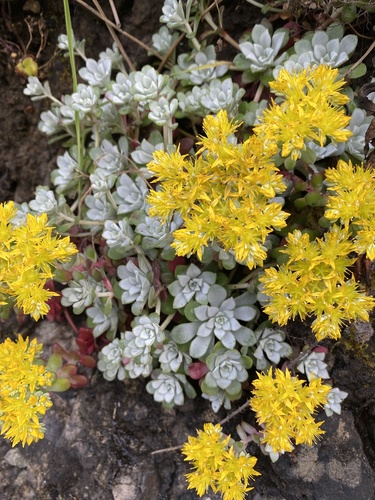
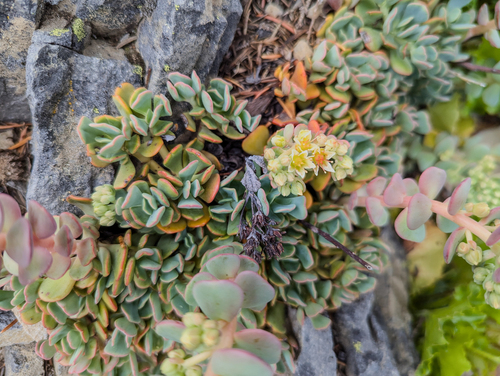
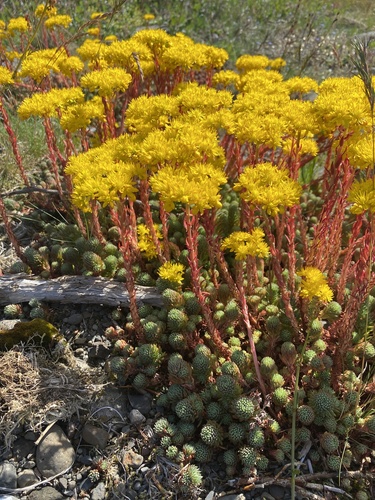
Petrosedum forsterianum (Sm.) Grulich produces two distinct types of shoots. Creeping, non-flowering shoots root as they spread, while flowering stems grow upright. Non-flowering shoots have tightly packed scale-like leaves clustered at their tips, which give the shoots a cone-like appearance. These leaves are linear in shape, slightly rounded or somewhat flattened, and have a small spur at the base. They are usually green or bluish-green, measure 10–15 mm long, and remain attached to the plant after dying, turning brown as they age. The species is evergreen. Populations in Britain have a compact, slow-growing habit instead of the typical creeping form, while plants from North Africa have distinctly bluish-purple foliage. Upright flowering stems reach 10–40 cm (4–16 in) when blooming. Flowers are arranged in branching clusters called corymbs; each branch curves downward while in bud, and straightens as the flowers open. Flowers usually have five to seven, sometimes up to nine, bright yellow petals that spread outward. The small, leaf-like sepals at the base of the flower are triangular with pointed tips, and grow up to 3 mm long. The pollen-producing stamens are also yellow. Flowering peaks in early summer. After blooming, the plant produces upright, pale brown seed capsules marked with distinct ridges. The chromosome count of this species is variable, with 2n = 24, 48, 60, 72, or 96. A cristate form of the plant can occur, but it is much rarer than the cristate form found in P. rupestre. The natural distribution of Petrosedum forsterianum covers England, Wales, Ireland, France, Germany, Spain, Portugal (including the Azores), and Morocco. It grows best in rocky habitats, where it forms dense, low-growing mats. It is often found on the shaded edges of glades, and is common growing in the shade of shrubs. Shrubs act as nurse plants for young specimens, and continue to provide partial shade for mature plants. Petrosedum forsterianum is edible, and can be added to salads and soups. It is also used for green roofs. This plant adapts well to a wide range of soils as long as good drainage is provided. It performs best in dry to moderately moist conditions with plenty of sunlight, can tolerate partial shade, and withstands both heat and humidity. It prefers sandy or gravelly soil with low fertility. In garden settings, the plant will naturally expand over time. Except for British populations and diploid North African populations, this species spreads too aggressively to be suitable for a typical rock garden. It works well as ground cover when contained, for example when grown in a pot. While it self-seeds easily in other growing settings, it remains manageable. The British form is less aggressive, but produces fewer flowers and has less vibrant foliage color. During hot, dry summers with intense sunlight, P. forsterianum often withers and may break apart; its tightly clustered rosettes can reestablish once moisture returns. It is fully hardy throughout temperate climates, but prefers shadier, wetter growing conditions than its close relatives. Pests and diseases do not usually affect this plant, though slugs, snails, and scale insects may occasionally attack it.