About Petrophile pedunculata R.Br.
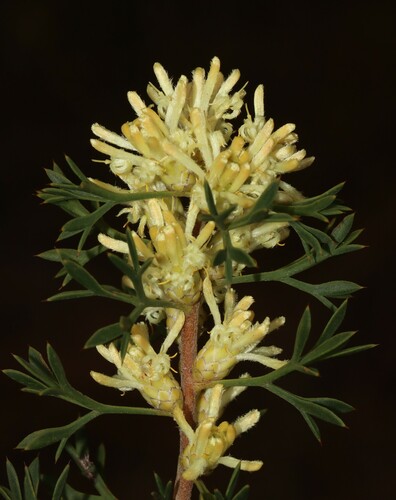
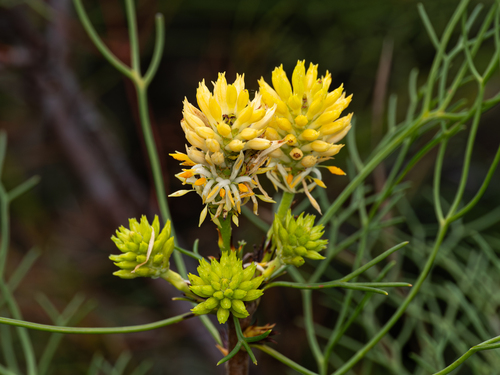
Petrophile pedunculata is an erect, spindly to bushy shrub that usually grows to a maximum height of 2.5 metres (8 feet 2 inches). It has hairless branchlets and leaves. Its leaves are pinnate, with needle-shaped, non-sharply pointed leaf segments. The entire leaf ranges from 70 to 185 millimetres (2.8 to 7.3 inches) long, attached to a stalk (petiole) between 25 and 95 millimetres (0.98 to 3.74 inches) long, and individual pinnae are usually less than 20 millimetres (0.79 inches) long. Flowers are arranged in oval heads that grow in leaf axils, 10 to 15 millimetres (0.39 to 0.59 inches) long, on a stalk (peduncle) that is also 10 to 15 millimetres (0.39 to 0.59 inches) long. Individual flowers are about 7 to 10 millimetres (0.28 to 0.39 inches) long, yellow or cream-coloured, and covered with a small number of soft hairs. Flowering takes place between October and January. After flowering, the fruit is a nut that fuses with other nuts to form an oval head, which grows up to 40 millimetres (1.6 inches) long on a peduncle about 20 millimetres (0.79 inches) long. This species can be told apart from the closely related Petrophile pulchella because P. pulchella has flower heads that are either sessile or held on peduncles no longer than 10 millimetres (0.39 inches). Petrophile pedunculata grows in shallow sandstone soils, most often in open forest or heathland habitats. It is common along the coast of New South Wales between Port Jackson and Milton, and also occurs in the ranges between the Blue Mountains and Marulan.