About Petrophile canescens A.Cunn. ex R.Br.
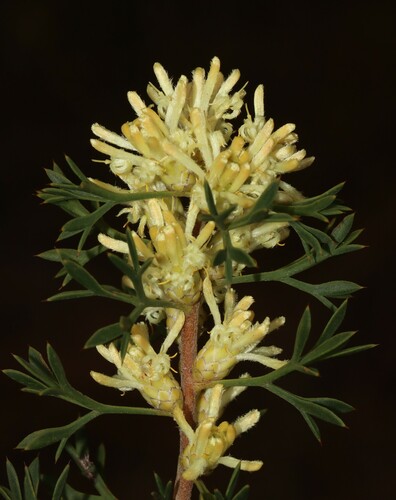
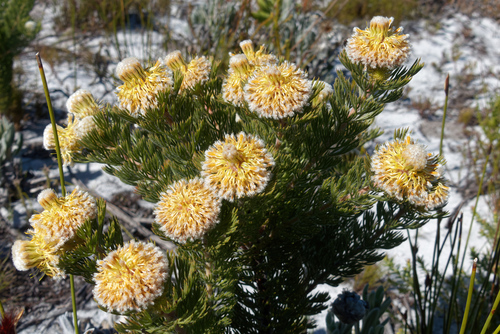
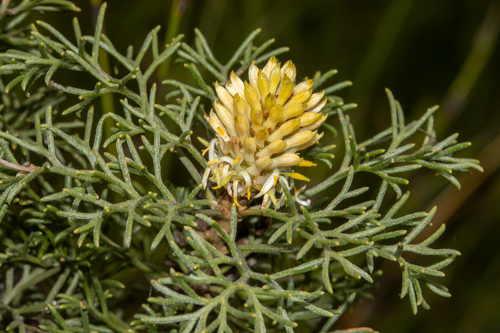
Petrophile canescens A.Cunn. ex R.Br. is an erect shrub that usually grows between 0.5 and 3 metres (1 foot 8 inches to 9 feet 10 inches) tall. Its young branchlets and leaves are covered in silky grey hairs. The leaves are cylindrical, 30 to 110 millimetres (1.2 to 4.3 inches) long, borne on a petiole 20 to 50 millimetres (0.79 to 1.97 inches) long, and pinnately divided, with the undivided section of the leaf longer than the divided section. The flowers are arranged in sessile, oval flower heads that are 10 to 25 millimetres (0.39 to 0.98 inches) long, sometimes growing in groups of up to four. Hairy, triangular involucral bracts are present at the base of each flower head. The individual flowers are 9 to 12 millimetres (0.35 to 0.47 inches) long, white to pale cream in colour, and covered in silky hairs. Flowering takes place from September to January, and the fruit is a nut that is fused with other nuts in an oval to spherical head 15 to 40 millimetres (0.59 to 1.57 inches) long. This species of Petrophile can be told apart from the related species Petrophile pulchella by its finely hairy new growth. The plant, commonly called conesticks, grows in forest and sandy heath habitat. It is found on the Blackdown Tableland in Queensland, ranging south to Nerriga and west as far as Warialda in New South Wales.