About Petromyzon marinus Linnaeus, 1758
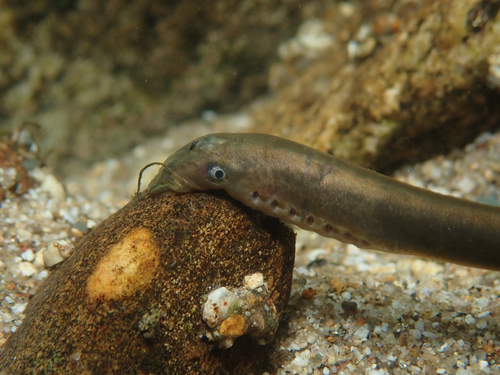
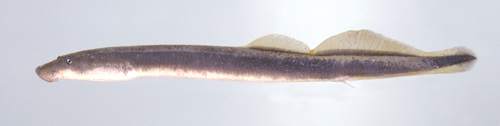
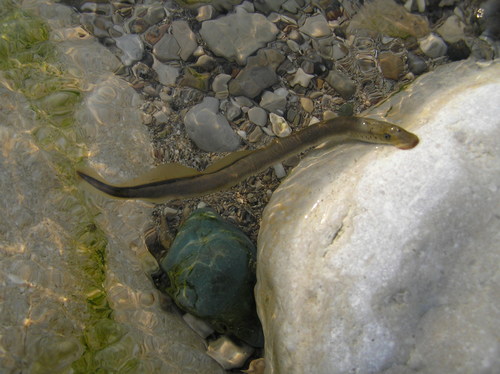
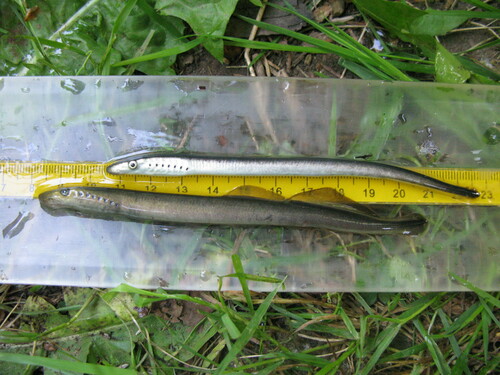
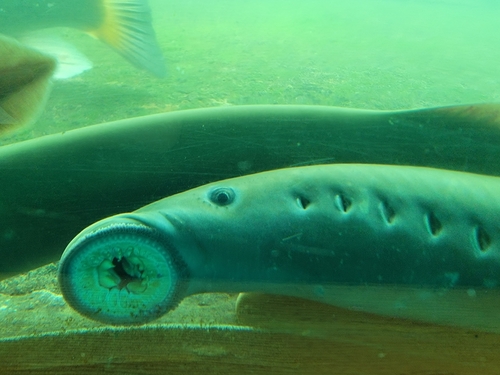
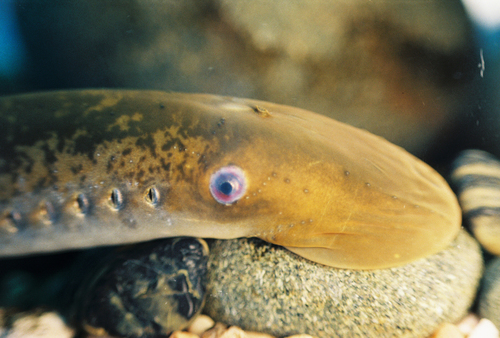
Petromyzon marinus, the sea lamprey, has an eel-shaped body with no paired fins. It has a jawless, round, sucker-like mouth that is at least as wide as its head. Sharp teeth are arranged in many concentric circular rows around a sharp, rasp-like tongue. Seven gill openings sit behind each eye. The dorsal and lateral sides of the body are olive or brown-yellow with black marbling, and the belly is lighter in color. Sea lampreys have a maximum total lifespan of seven years; fully grown adults can reach up to 120 cm (47 in) in length and up to 2.3 kg (5.1 lb) in weight. This species is native to the northern and western Atlantic Ocean along the coasts of Europe and North America, and is also found in the western Mediterranean Sea and the Black Sea. It is an invasive species in the North American Great Lakes and Lake Champlain, located between New York and Vermont, United States. It is native to the Connecticut River basin in the United States. The largest European populations are found across southwestern Europe, specifically in north-central Portugal, north-northwest Spain, and west-southwest France; these same regions host the main fisheries for the species. Sea lampreys occur at depths of up to 4,000 metres (13,120 ft) and can tolerate water temperatures between 1 and 20 °C (34 to 68 °F). Sea lampreys are anadromous: they migrate from their sea or lake habitats up into rivers to spawn. Males build nests in the substrate of moderately fast-flowing streams, where females lay large numbers of eggs. All adult sea lampreys die after spawning. Newly hatched larvae burrow into the sand and silt of slow, quiet downstream water, filter-feeding on plankton and detritus. After spending several years in freshwater, larvae complete metamorphosis. Post-metamorphic young lampreys then migrate to the sea or lakes to begin their adult hematophagous (blood-feeding) lifestyle. Some individuals begin blood-feeding in rivers before migrating out to sea. As adults, sea lampreys prey on a wide range of fish species. They use their suction-cup mouth to attach to a fish's skin, then rasp away tissue with their sharp rasping tongue and keratinized teeth. They produce an anti-clotting fluid called lamphredin in their mouth that stops the host's blood from clotting. Most host fish die from excessive blood loss or secondary infection. After one year of hematophagous feeding, adult lampreys return to rivers to spawn and die, roughly one and a half years after they finished metamorphosis. Sea lampreys are considered a delicacy in parts of Europe, and are sold seasonally in France, Spain, and Portugal. In Finland, they are served pickled. In Latvia, sea lampreys are occasionally caught alongside river lampreys in local rivers, where most commercial catch of lamprey is the smaller river lamprey that is typically cooked or grilled.