About Petrolisthes eriomerus Stimpson, 1871
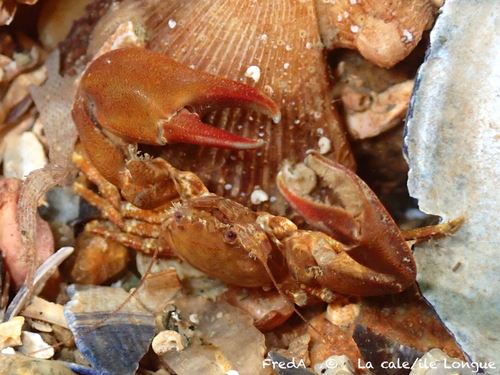
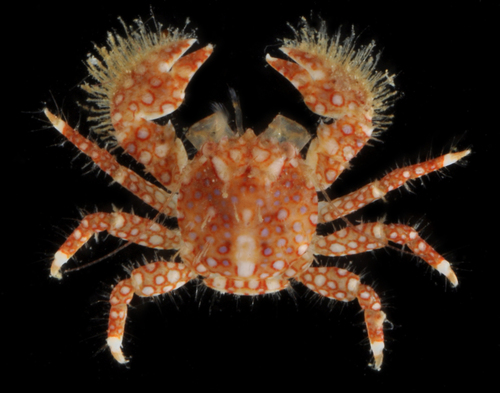
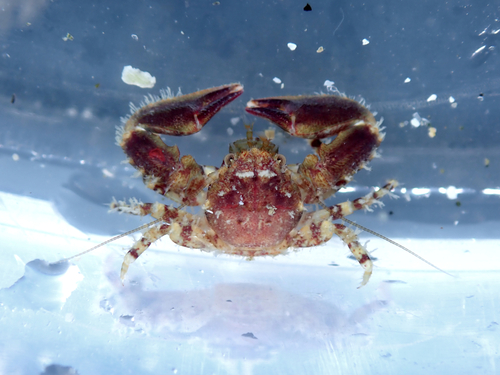
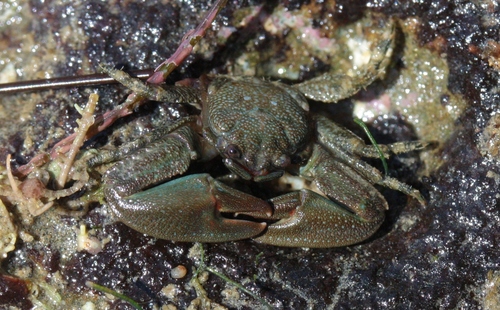
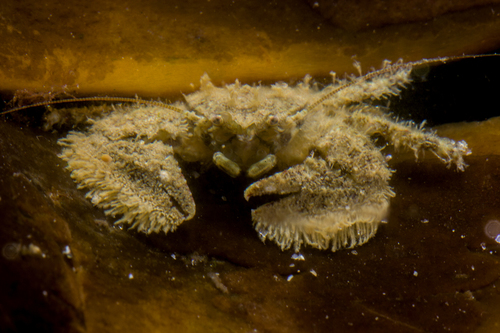
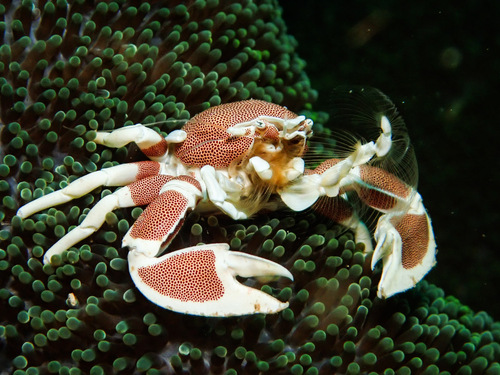
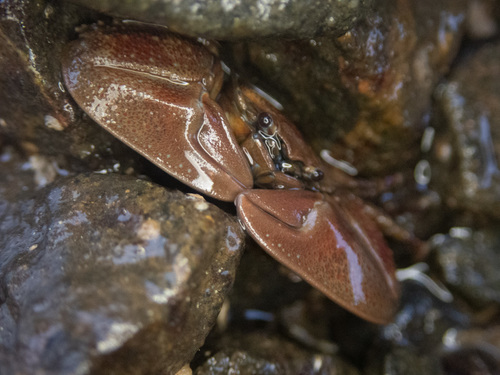
Petrolisthes eriomerus, commonly known as a porcelain crab, differs from true crabs in having only four normally visible walking limbs (pereiopods) instead of five, and is more closely related to king crabs and hermit crabs. This small porcelain crab has a rounded carapace that reaches up to 20 millimetres (0.79 in) wide. Its body, limbs, and claws are flattened along the dorsal side. A pair of long antennae sits just beside the eyes. The broad carpi of its claw-bearing chelipeds have parallel sides and are twice as long as they are wide, a trait that distinguishes this species from the otherwise similar Petrolisthes cinctipes. The chelipeds bear claws that are usually similar in size; these claws are half as long again as the carpus, and are disproportionally large. The second through fourth pereiopods end in a pointed, moveable dactyl, while the fifth pereiopod is rudimentary and tucked under the abdomen. A long abdomen, folded under the thorax, has attached uropods. The limbs are covered in tufts of setae, which are most visible when the crab is underwater. This species is mainly reddish-brown or blueish-grey, but its palps, some mouthparts, and the knuckles of the cheliped dactyls are blue. This crab occurs on western North American coasts from California to Alaska, living from the shore down to depths of up to 90 metres (300 ft). It favors areas with strong currents, and can be found under rocks (especially rocks embedded in sand or shingle), among seaweed, and in mussel beds, on both exposed and sheltered coasts.