About Petrolisthes armatus (Gibbes, 1850)
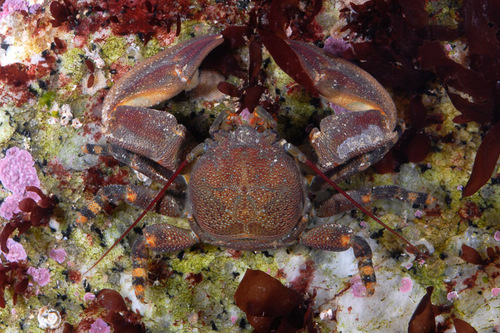
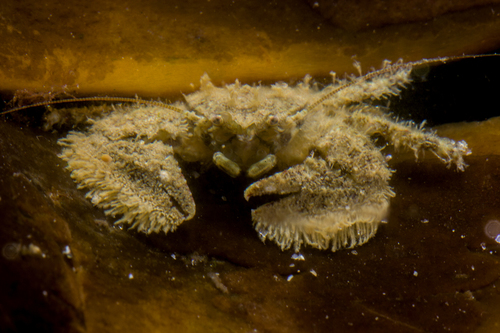
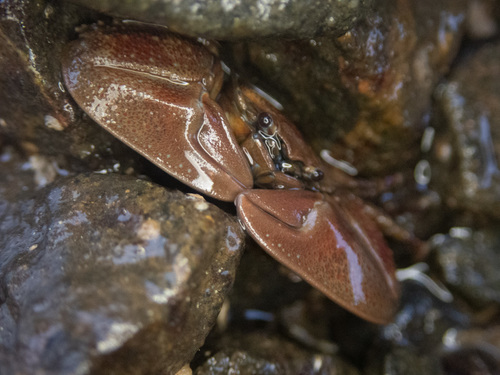
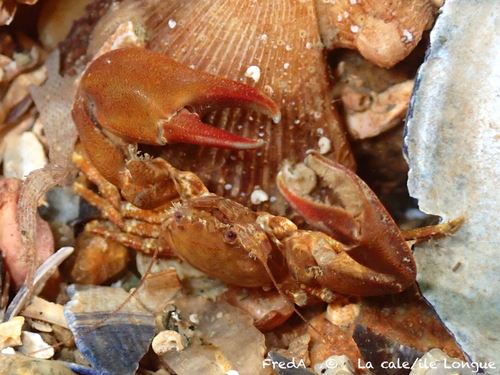
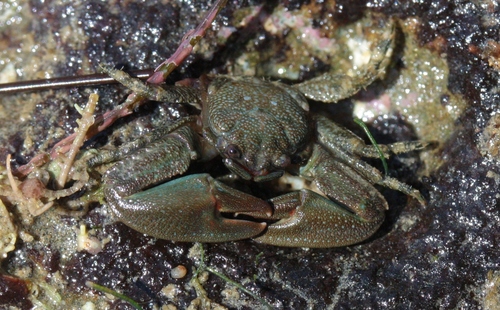
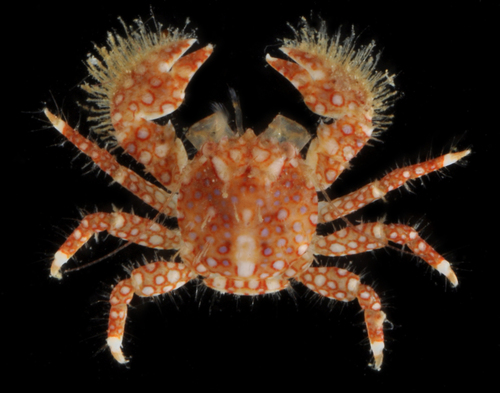
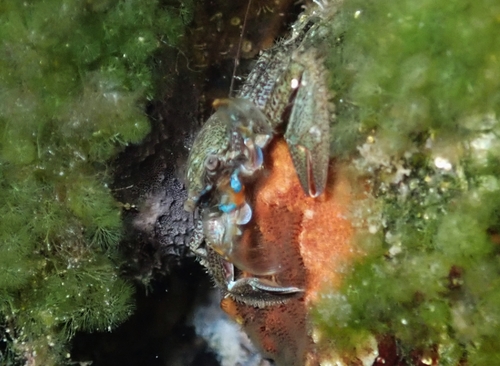
The carapace of Petrolisthes armatus is roughly oval with a bluntly pointed front, granulated, and covered with shallow, narrow ridges. This species has two long chelipeds with pincers called chelae, three pairs of walking legs, and a vestigial fourth pair. The chelipeds are made of four segments instead of five, and the chelae are long, with a distinctive orange spot that becomes visible when the chelae are parted. The antennae, which have a spine on the first segment, are positioned outside the stalked eyes. This placement is characteristic of porcelain crabs, differing from most other crab families, where antennae are located between the eyes. Petrolisthes armatus is a very small species, with an individual length ranging between 6 and 8 mm (0.24 and 0.31 in) and an average weight of about 0.5 g (0.02 oz). Its base color is generally brown or dark olive-green; juveniles are typically paler and mottled. The mouthparts sometimes have bright blue sections, and the entire animal may occasionally be bright blue. Petrolisthes armatus is thought to have originated off the coast of Brazil, though this origin is not confirmed. By the 1930s, the species was recorded off the east coast of Florida, and has since spread across all of Florida, Georgia, and South Carolina. It is also found along the tropical west African coast, at Ascension Island, Bermuda, the Bahamas, the Caribbean Sea, the Gulf of Mexico, the West Indies, and the tropical Atlantic coast of South America. It also occurs in the eastern Pacific, ranging from the Baja California Peninsula southward to Peru, and has been recorded off the coast of Panama since 1850, before the Panama Canal was constructed. Its depth range extends from the lower intertidal zone to the shallow subtidal zone, and it lives on rock rubble, in oyster beds, on soft sediments, and in mangroves. On the coasts of South Carolina and Georgia, Petrolisthes armatus has become extremely abundant, with recorded densities as high as 30,000 individuals per square metre (2,800 per square foot). This high abundance has raised concerns over its impact on the local environment, its competition with native species, and its potential effect on shellfish production in oyster beds. It is likely that the larvae of this species are carried to new locations in ship ballast water, or that the species was introduced during seeding of oyster or other shellfish beds for aquaculture.