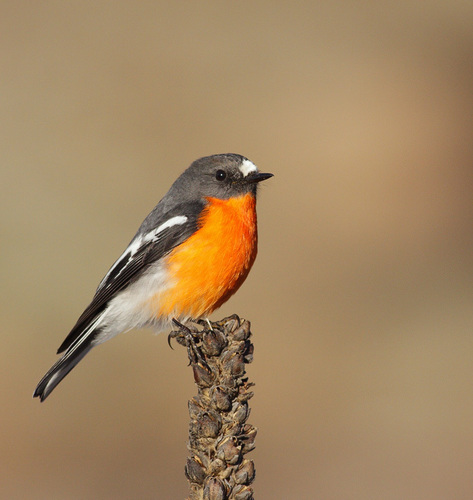
About Petroica phoenicea Gould, 1837
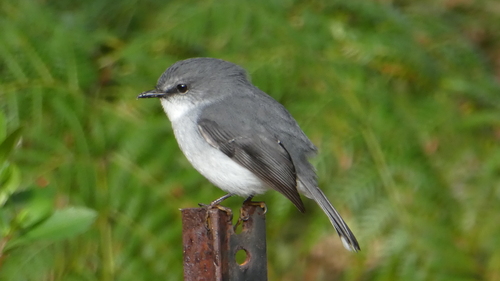
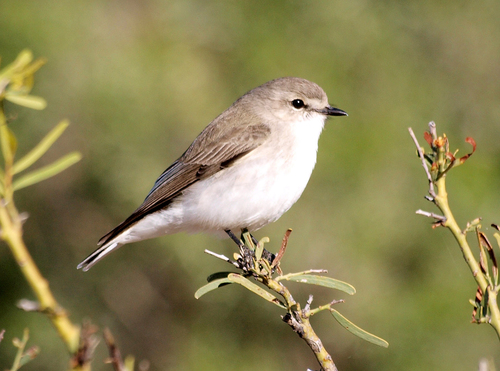
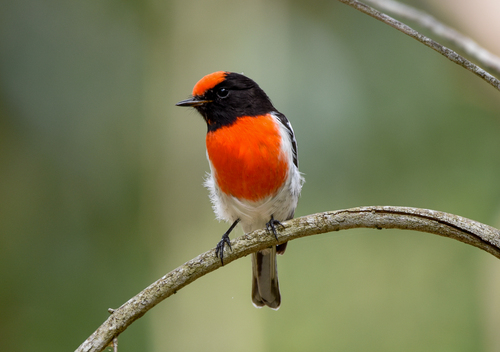
The flame robin (Petroica phoenicea Gould, 1837) is the largest of the red robins, measuring 12–14 cm (4.7–5.5 in) in length. Compared to other members of the genus Petroica, it has a more slender build, with relatively long wings and neck, and a small head. Males are easily recognized by their bright orange-red plumage on the throat, breast, and abdomen. The crown, nape, ear coverts, hindneck, and sides of the neck are dark grey, while the lores and chin are grey-black. Grey feathers on the sides of the crown may be mixed with dull orange. The rest of the upperparts, including the wings, back, and tail, are dark grey. There is a small white frontal spot above the bill, and the wing bar and outer tail shafts are also white. Feathers on the posterior belly, flanks, and vent are white with grey-black bases. Females are plain in colour, with pale brown overall plumage and a lighter buff underside. The lower belly, sides, and undersurface are a soft off-white. Like males, females may have a subtle dull orange tint on the sides of the crown, and this colour can also extend to breast feathers. They have small off-white marks on the wings and above the bill. The bill, legs, feet, and claws are black, and the eyes are dark brown. In September 1950, a flame robin with an entirely lemon-yellow breast and otherwise female plumage was observed in a small flock near Swansea, eastern Tasmania. Nestlings have dark grey or brown down, cream to grey bills, cream gapes, and orange throats. Juvenile plumage during the first moult resembles adult female plumage, but the head and upperparts are streaked and slightly darker. Soon after fledging, juveniles moult into their first immature plumage, which more closely resembles that of the adult female. Male juveniles may have some orange feathers on the breast. Birds in their second year moult into a second immature phase; some males in this phase resemble adult males, while others retain the more immature brown plumage. It is very difficult to determine the age and sex of birds with brown plumage. Information on the exact timing of moulting is lacking, but primary feather replacement occurs over the summer months between December and February. Colour alone is not a reliable guide for identifying this species, as some scarlet robins (P. boodang) develop an orange hue. Unlike male scarlet and red-capped robins (P. goodenovii), which have red breasts and black throats, the flame robin's breast plumage extends all the way to the base of the bill. It is also slightly slimmer and has a smaller head than the scarlet robin, and is clearly larger than the red-capped robin. Females of these related species are harder to distinguish. Female red-capped, rose, and pink robins are all smaller, with wing lengths less than 7 cm (2.8 in), smaller than even the smallest flame robin. The female scarlet robin has a more prominent red flush on the breast, and the forehead spot above the bill is more prominent and white rather than off-white. The flame robin's calls are divided into louder and quieter types. Louder calls can be heard from 150 m (490 ft) away, while quieter calls, which are often briefer, can be heard from 30 m (98 ft). Loud songs make up almost 90% of calls in spring, summer, and autumn, but less than 50% of calls from May to July. Males sing rarely during this period, though they do sing to defend their territories. The flame robin's song is more varied and complex than that of the scarlet robin, and has been described as the most musical of all red robins. The musical song consists of a series of descending notes grouped in threes, and has been compared to the phrases "you-may-come, if-you-will, to-the-sea" or "you-are-not a-pretty-little-bird like-me". Both males and females sing this song, often while perched on a vantage point such as a stump or fence. This loud song is used to attract potential mates, and to announce the delivery of food to a mate or young. The softer call has been described as a tlip, terp or pip, and is used as a contact call near the nest. When approached while nesting, the female makes a hissing sound, and the male has been recorded making a wheezing call when displaying around the nest. The flame robin is found in temperate regions of southeastern Australia and across all of Tasmania, though it is less common in southwestern and western Tasmania. In Victoria, it is more common in uplands than at lower altitudes. Its range extends from the Adelaide and Murray Plains around the mouth of the Murray River in southeastern South Australia, across Victoria, and into the South West Slopes and southern regions of New South Wales. Further north, it occurs along the Great Dividing Range and its western slopes, with a few recorded sightings from southeast Queensland. Across most of its range, the flame robin is generally migratory, moving from alpine and subalpine regions to lowlands in winter, though its breeding and non-breeding ranges overlap. There is some evidence that males migrate several days earlier than females. It is unclear what proportion of Tasmanian flame robins cross Bass Strait to winter in Victoria. Birds that remain in Tasmania leave their breeding areas and gather in loose flocks of up to fourteen birds in paddocks. They leave these areas by August, and immature birds appear to disperse earlier. A field study conducted in the outer Melbourne suburb of Langwarrin found that climate did not influence the peak abundance of flame robins at the site. In 2004, BirdLife International regraded the flame robin from Least Concern to Near Threatened, due to population decline over the preceding 25 years. The Australian Government has classified the species as Least Concern, but noted evidence of decline at the edges of its non-breeding range: it has become rare in South Australia, and uncommon in the lowlands of Victoria. Flame robins are not rare in the Victorian high country. They are frequently encountered at high elevations on the Great Dividing Range, especially in open snow gum woodland and similar habitat, and during the summer breeding season are one of the most reliably observed species around the summit of Mount Macedon, northwest of Melbourne. In spring and summer, the flame robin is most often found in wet eucalypt forest in hilly or mountainous areas, particularly on hilltops and slopes, up to an elevation of 1,800 m (5,900 ft). It generally prefers areas with more clearings and less understory. It specifically favours tall forests dominated by trees including snow gum (Eucalyptus pauciflora), mountain ash (E. regnans), alpine ash (E. delegatensis), manna gum (E. viminalis), messmate stringybark (E. obliqua), black gum (E. aggregata), white mountain gum (E. dalrympleana), brown barrel (E. fastigata), narrow-leaved peppermint (E. radiata), and black peppermint (E. amygdalina). It is occasionally found in temperate rainforest. In autumn and winter, birds move to more open areas at lower altitude, such as grasslands and open woodlands, particularly those containing river red gum (E. camaldulensis), Blakely's red gum (E. blakelyi), yellow box (E. melliodora), grey box (E. microcarpa), and mugga ironbark (E. sideroxylon). Flame robins often become more abundant in areas recently burnt by bushfires, but move away once the undergrowth regrows. They may also move into logged or cleared areas within forests. However, a field study in Boola Boola State Forest in central Gippsland found that they do not occur in areas with dense regrowth after logging.