About Petroica goodenovii (Vigors & Horsfield, 1827)
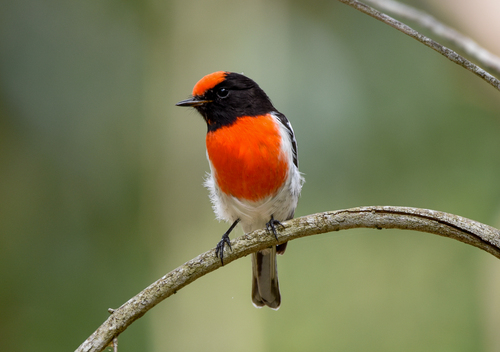
The red-capped robin (Petroica goodenovii) is the smallest of the red robins. It measures 10.5–12.5 cm (4.1–4.9 in) in length, has a 15–19.5 cm (5.9–7.7 in) wingspan, weighs around 7–9 g (0.25–0.31 oz), and males and females are similar in size. It has longer legs than other robins in the genus Petroica. Males have a distinct scarlet cap and scarlet breast, jet-black upperparts with white shoulder bars, a black tail with white tips, and white underparts and shoulders; all of its colours are sharply defined from one another. Females are plain grey-brown on the upper body, with a reddish tint to the crown, paler underparts, dark brown wings, and a pale buff patch on the wings. Some females also have a reddish tint to the breast. Both sexes have a small black bill, dark brown eyes, and dark brown legs. Immature birds initially look like females; males do not grow their distinctive adult plumage until their second moult, which occurs at around one year of age. Red-capped robins moult once a year, after the breeding season, between December and April. Two red keto-carotenoid pigments—canthaxanthin and adonirubin—produce the red colouring in the species' plumage. Red-capped robins cannot make these compounds on their own, so they must get them from their food. Carotenoids are energetically costly to metabolize, and are also needed for immune function, so only red-capped robins in good condition have enough carotenoids left to use for red feathers. This means red plumage acts as a good signal to potential mates. A 2001 field study conducted at Terrick Terrick National Park in Victoria found that males with greater reproductive success and better condition grew brighter plumage when they moulted the following year. However, male age and condition at the time of the study were more accurate predictors of mating success in the next breeding season. Adult males can begin breeding at one year of age, and may even breed while still in non-breeding plumage, but they have lower reproductive success at this age. The oldest recorded red-capped robin lived to 5 years and 7 months; this individual was banded near Beverley, Western Australia, in 1990. Recorded calls of the species include two distinct song types, described as 'tinkle' and 'blurt' songs. These songs are similar across mainland Australia, but differ on Rottnest Island; birds on this isolated island rarely connect successive songs into longer sequences. This species can be mistaken for the closely related flame robin (P. phoenicea) and scarlet robin (P. boodang). Males can be easily distinguished by their red crown (which is white in the other two species) and smaller size; additionally, male flame robins have dark grey rather than black upperparts. Female and immature red-capped robins are harder to tell apart from females and immatures of the other two species, but can be identified by the reddish tint on their crown and their whiter underparts. The red-capped robin is found across mainland Australia, and is absent from Tasmania, Cape York, the Top End, and most of the Kimberley, though there are occasional sightings in the southernmost Kimberley. Offshore populations live on Rottnest Island, and Greenly and Pearson Islands off the Eyre Peninsula; the species is not found on Kangaroo Island. Though it has a wide range, it is uncommon in many areas. It is rare east of the Great Dividing Range, in southern coastal regions of the continent, and in the northern parts of its range, and is seldom seen north of 20°S. The species' movements are generally poorly understood, especially outside of the breeding season. It stays in one place year-round across most of the southern part of its range, but is only a spring and summer visitor to the Nullarbor Plain, the Adelaide region of South Australia, and central Victoria. It is a winter visitor in the northern parts of its range. Compared to its close relatives, the red-capped robin prefers more arid habitat, and occupies drier areas where it occurs alongside the scarlet robin, which lives in wetter forests. The red-capped robin's preferred habitat is dry Acacia, Callitris, or mixed scrubland or woodland, dominated by species including mulga (Acacia aneura), Georgina gidgee (Acacia georginae), raspberry jam (Acacia acuminata), black cypress-pine (Callitris endlicheri), white cypress-pine (C. columellaris), and slender cypress-pine (C. preissii), with understory shrubs like Cassinia, hop-bush (Dodonaea), emu bush (Eremophila), and spinifex (Triodia).