About Petroica australis (Sparrman, 1788)
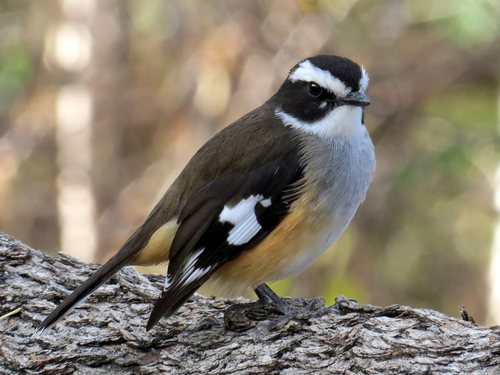
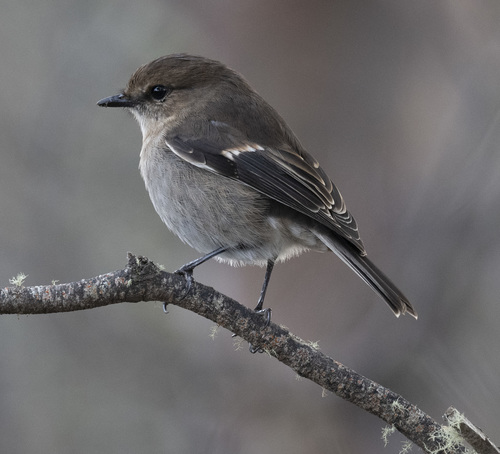
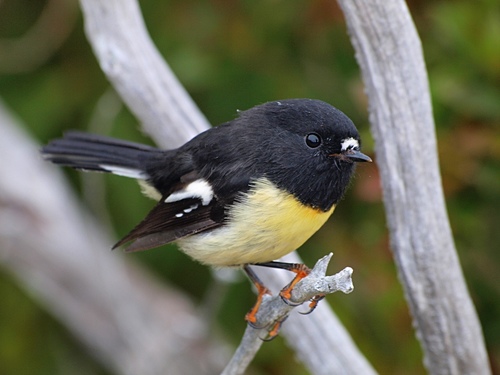
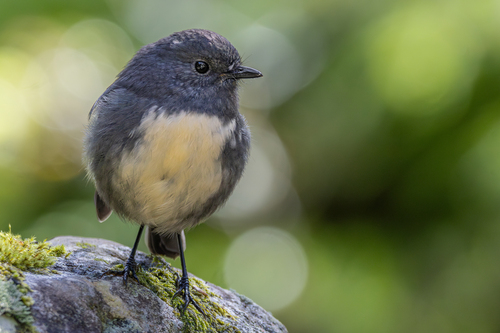
The South Island robin, with the scientific name Petroica australis (Sparrman, 1788), is a small passerine bird. It measures 10–18 cm in length and weighs approximately 35 grams. North Island robins resemble both female and juvenile South Island robins, as well as all Stewart Island robins, which can make distinguishing the three groups difficult. Within any single population of these robins, females and juveniles look similar to one another, though newly independent juveniles may not yet have developed their lighter colored breast patch. Male North Island robins are almost black, with a white spot just above the beak and a greyish-white lower breast. Female and juvenile North Island robins are greyer, with more variable pale patches on their breasts and throats. Male South Island robins are dark grey aside from a distinct yellowish-white lower chest; females and juveniles of this group are lighter grey with a less distinct breast patch. Stewart Island robins of both sexes look similar to North Island robins of matching sexes. New Zealand robins are relatively long-lived, with wild lifespans of at least 14 years recorded. Historically, the South Island robin occupied most of the lowlands of New Zealand's South Island. Over the last century, habitat loss and introduced predation have made its distribution much more fragmented across the island. It now has two populations on the South Island's east coast, and is slightly more common in the northern and western parts of the island. South Island robins have fared slightly better than Stewart Island robins. Stewart Island robins are now restricted to just three subpopulations, all located in Leptospermum swamp scrubland. While this is not the species' preferred habitat, it has lower populations of predatory mammals. At one point, the total Stewart Island robin population fell below 500 individuals. A translocation programme to establish new populations on predator-free islands including Ulva Island, Motuara Island, and Nukuwaiata Island has been relatively successful; around 600 individuals now live on Motuara Island alone. Within the South Island, South Island robins show a strong preference for Douglas fir plantations over native kanuka forests or Monterey pine plantations. This preference appears to be linked to forest structure rather than food availability or suitable nesting sites: the species favors structurally simple forests with dense, uniform canopies and leaf litter covering the ground. After the species was introduced to Ulva Island, nesting success was positively correlated with the presence of broad-leaved coastal vegetation. South Island robins generally respond well to pest control programmes that use aerial 1080 poison operations. These operations have been associated with increased chick and adult survival, and increases in overall population size. A 2012 University of Otago study of a marked South Island robin population during an ongoing 1080 poison operation using cereal baits found no negative impact on robins, and suggested that reducing predation pressure from introduced mammals would likely lead to population growth. However, some South Island robin deaths from accidental 1080 poisoning after pest control operations have been recorded. Most of these deaths were linked to four specific 1980s operations that used poor-quality carrot baits.