About Petrogale penicillata (Gray, 1827)
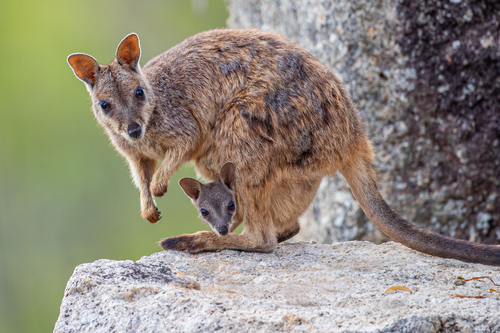
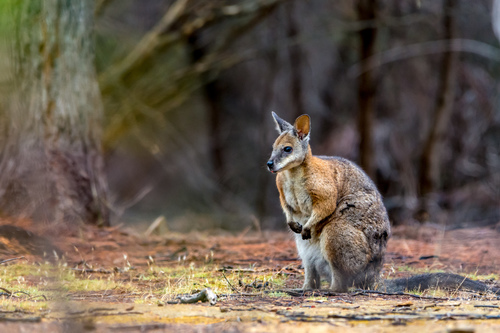
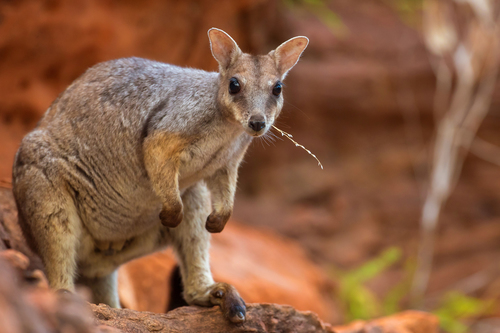
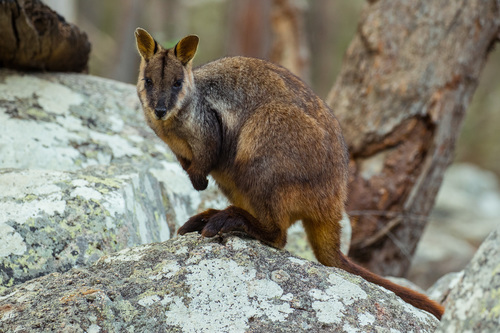
This species is a member of the Petrogale (rock wallaby) genus. It has dense, shaggy fur that is either rufous or grey-brown. Its tail measures 500 to 700 millimetres in length, which is longer than the combined head-and-body length of 510 to 580 millimetres. The tail is brown or black, with fur becoming bushier toward its shaggy, brush-like tip. Adults weigh between 5 and 8 kilograms. The upper parts of the pelage are either entirely rufous-brown, or grey-brown over the back and shoulders with brown fur on the thighs and rump. The paler underparts may have a white marking on the chest. Very dark fur covers the lower limbs, paws, feet, and the sides beneath the forelimbs; a whitish stripe may run along the side of the body. Individuals from the northern part of the species' population have paler coloration and shorter fur. It can be distinguished from the related central Australian species Petrogale lateralis (black-footed rock-wallaby), which is larger and has shorter, darker fur on the tail and hindquarters. It also overlaps in range with Herbert's rock-wallaby (P. herberti) in its northern area; P. herberti has greyer coloration than this species' warm brown fur, lighter dark limb features, and lacks the blackish coloration and bushy tip on the tail. The foot pads of this species are well developed, with a coarse texture that provides good traction on rock surfaces. This species is found along the Great Dividing Range in fragmented populations, which remain after the species' historical range contraction across its eastern and southern former range. The southern edge of its current range is the Grampians, and it does not occur further west than the Warrumbungles range in New South Wales. The northernmost populations, found in southeast Queensland, have been less affected by ecological changes. During the day, Petrogale penicillata shelters in rocky habitat, within vegetation or cavities, preferring complex terrain that lets it access cooler temperatures and avoid or remain inaccessible to predators. It is highly agile when hopping and climbing, allowing it to use ledges, cliff faces, overhangs, caves, and crevices.