About Petrochelidon pyrrhonota (Vieillot, 1817)
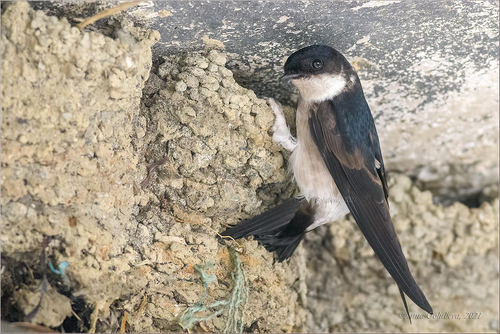
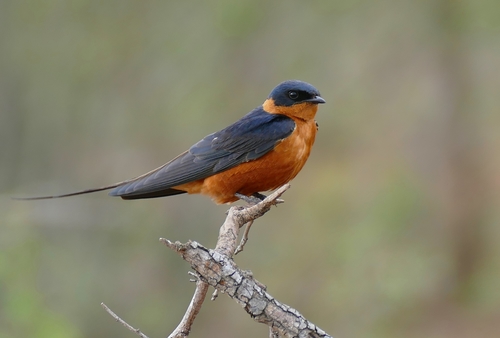
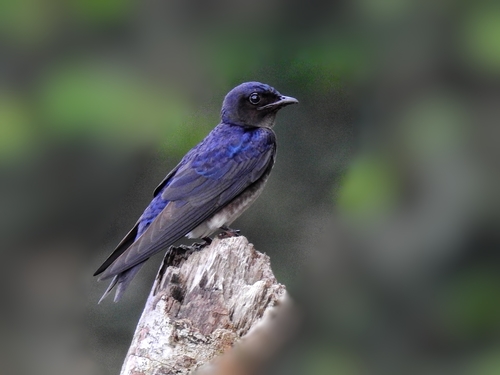
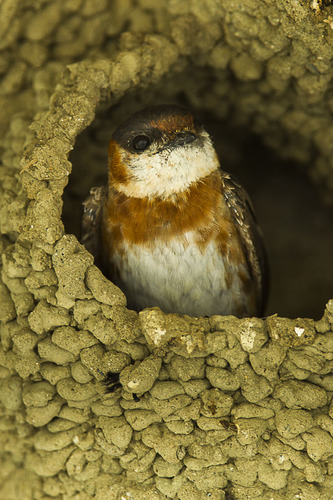
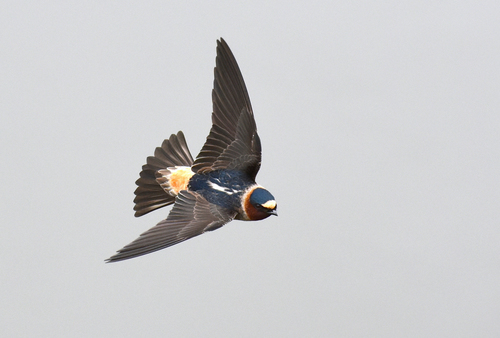
The cliff swallow (Petrochelidon pyrrhonota) has an average body length of 13 cm (5.1 in), with short legs, small bills, and relatively long pointed wings. Adult cliff swallows have dark brownish plumage across their back and wings, a characteristic white forehead, rich red cheeks, a dark throat, plain white underparts, and a buff-colored rump. In good lighting, their crown and mantle feathers show iridescence. Northern populations are slightly larger and have different facial markings than Mexican populations, which have a chocolate-brown patch on the forehead. Males and females have identical plumage, so sexing must be done by palpating the cloaca: during breeding season, males have a harder, more prominent cloaca due to swollen seminal vesicles. During incubation, females lose feathers on their lower breast to create a warm brood patch for their eggs. Cliff swallows have similar body plumage coloring to the related barn swallow, but lack the barn swallow's distinctive fork-shaped tail that is prominent in flight; cliff swallows have a square-shaped tail. Juvenile cliff swallows have overall similar body plumage coloring to adults, but with paler tones. They lack the iridescent plumage of adults, and their foreheads and throats appear speckled white. These white facial markings vary much more between unrelated juveniles than between juveniles from the same clutch. These distinctive white facial markings disappear after maturity following their complex-basic moult pattern, because their pre-formative plumage differs from their basic plumage. It has been suggested that these pre-formative facial markings may allow parents in large nesting colonies to recognize their own chicks. As their common name suggests, cliff swallows historically concentrated their nesting colonies along mountain cliffs, primarily on the western North American coast. Today, with the development of highways, concrete bridges, and buildings, this adaptable bird species is rapidly shifting its typical nesting sites, with populations expanding further east and building their mud nests on these concrete structures. The cliff swallow's breeding range now covers large areas across Canada and the United States, excluding some southern and northern regions. Most nesting colonies are located close to fields, ponds, and other ecosystems that support large populations of flying insects, which meet the birds' energy needs during the breeding season. Cliff swallows winter in South American countries including southern Brazil, Uruguay, and parts of Argentina. Their behavior and populations on wintering grounds have not been extensively studied, so much remains to be learned about the species in this part of its range. Cliff swallows are long-distance day-migrants that generally travel along North American coastlines; eastern populations travel through Florida, while western populations travel through Mexico and Central America to reach their winter destinations. Large mixed flocks of cliff swallows have been recorded migrating together, but it is not known whether flocks stay together or disperse to different locations. The cliff swallow breeding season begins when the birds return from their wintering grounds. They usually arrive in large groups and immediately begin choosing nesting sites. Cliff swallows may skip one to five years between breeding at the same site to avoid parasite infestations, though some pairs return to the same site annually. Colony size can affect reproductive success especially for younger pairs, as younger birds seem to rely on information gained from large colonies. Older birds are usually found in smaller colonies and nest earlier, avoiding parasite outbreaks that occur in the hot mid-summer. Upon arriving at the nesting site, cliff swallows decide whether they will repair an existing nest from the previous season or build a new nest. Building a new nest can have the benefit of lower parasite numbers, but it is very energy-intensive and time-consuming. Spending extra time building a new nest from scratch means breeding later, which can negatively impact chick survival. Nests built from sticky clay can last for multiple years, and are supported by the cliff swallows' tier-stacking construction strategy. Cliff swallows from the same colony socially collect mud for nest building; they can be seen converging at small muddy areas together, then carrying globs of mud in their bills back to their nests. Each breeding pair produces 3 to 4 nestlings per brood; a clutch size of 4 is the most common and the most reproductively successful. Female cliff swallows engage in intraspecific brood parasitism, moving or laying their eggs in neighboring nests. Females that practice brood parasitism tend to have higher reproductive success than females that are hosts to brood parasitism. Hosts must care for more chicks, which raises their energy costs and decreases their fitness, as they are raising young that do not carry their own genetic material. Male cliff swallows also contribute to gene spread by mating with multiple females, increasing genetic variation across the colony. Cliff swallow nesting sites are vulnerable to predation and takeovers by other cavity-nesting bird species, most notably the house sparrow. House sparrows search through many swallow nests to find a site for their own nest, and destroy numerous cliff swallow eggs in the process. Once house sparrows claim a nest, they add grass and other nesting material, making it impossible for cliff swallows to reclaim the nest. Nests, especially those on the periphery of colonies, are also vulnerable to snake predation. Central nests in colonies are more sought after, have larger clutches, and are preferentially reused in later breeding seasons. Colonies with house sparrow presence have lower overall breeding success, and fewer old nests from previous years are reused.