About Petrochelidon fluvicola (Blyth, 1855)
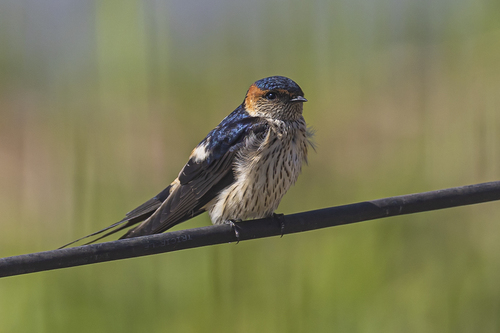
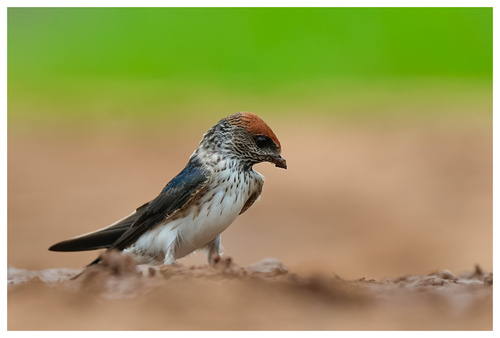
The streak-throated swallow, with the scientific name Petrochelidon fluvicola (Blyth, 1855), is a sparrow-sized bird that reaches about 11 cm (4.3 in) in length. It has a dull chestnut forehead and crown, whitish underparts, steel-blue upper feathers, a pale brown rump, and a square-ended tail. Distinctive brown streaks on its throat and chest set it apart from other similar bird species. On cold mornings, large flocks can be seen packed closely together on electric wires to bask in early sunlight. When perched, its voice is a twittering chirp, and in flight it makes a sharp trr-trr call. The streak-throated swallow is a year-round resident across most of South Asia. Its range extends from the plains of Pakistan east along the base of the Himalayas to Sikkim, and southwards through the Indian peninsula to Point Calimere in the Indian state of Tamil Nadu. It forms large colonies in cultivated fields and open areas located near ponds, lakes, canals, and rivers. The streak-throated swallow feeds on midges and other tiny winged insects, which it catches while flying. Its nesting season occurs across much of the year, covering two periods: December to April, and July to October. These birds build large colonial mud nests, made up of many individual pot-shaped nests fused together, with each nest accessed through a short entrance tube. Flocks of streak-throated swallows tend to stay attached to specific locations, which may be related to proximity to food sources. At a college in Rajasthan, India, a flock built a nesting colony around 9 m (30 ft) above ground, under the building's roof. When the nests were destroyed during building renovation in October 2010, the birds began rebuilding the nests within 4 days and finished reconstructing the colony within 4 months. Every year, even after their nests are destroyed during building cleaning, the flock returns to the same site and rebuilds the nesting colony.