About Petrochelidon ariel (Gould, 1842)
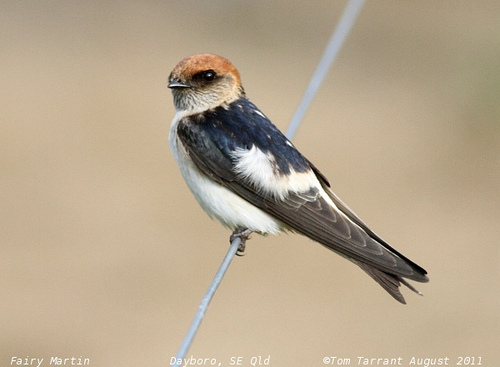
The fairy martin, with the scientific name Petrochelidon ariel (Gould, 1842), has a dumpy build and a square-shaped tail. On average, it measures 12 centimetres (4.7 in) in length and weighs 11 grams (0.39 oz). Adult fairy martins have an iridescent blue back, brown wings and tail, a rufous crown and nape, a whitish rump, and dull white underparts. The two sexes look similar. Young fairy martins are duller and browner than adults, with a paler forehead and pale fringes on their back and wing feathers. This species can be told apart from other Australian swallows by its pale rump. The tree martin, the species most similar to the fairy martin, has a shallowly forked tail and a blue-black head and nape. This is a vocal swallow species; its call is a chrrrr sound, and its song is a high-pitched twitter. Both of its vocalizations are higher pitched than those of the tree martin. After breeding, fairy martins leave their mud nests, and these vacated nests may be taken over by several species of microbats. The opportunistic microbat species that occupy these nests include three wattle bats from the genus Chalinolobus: Chalinolobus morio, C. dwyeri, and C. gouldii, as well as the small long-eared bat Nyctophilus geoffroyi.