About Petrea volubilis L.
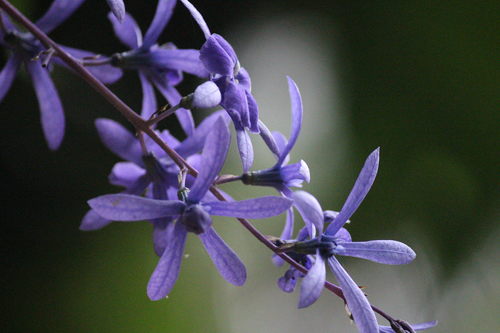
Petrea volubilis L. can grow as a climbing plant reaching 12 m (39 ft) in height, or as a shrub growing up to 4 m (13 ft) tall. It is a vine or semi-climbing shrub with puberulent stems that sometimes reach 10 cm (3.9 in) in diameter. Its leaves are elliptical-oblong, measuring 5–16 cm long and 3–8 cm wide, with an apex that is acute or obtuse, a wedge-shaped base, and an entire margin that is sometimes sinuous. Leaves are glabrous or pubescent, rough to the touch, and attach to stems with a 0.2–1 cm long petiole. Flowers emerge from bracts. Inflorescences are racemose, 8–20 cm long, axillary or terminal, and grow solitarily, with a puberulent rachis. The 5-parted flowers sit on puberulent pedicels, supported by a deciduous bract. The calyx tube is 0.2–0.7 cm long and glabrous or puberulent; the corolla is infundibuliform, 1 cm long, puberulent, and blue. It has an ovary and glabrous style. Its drupaceous fruit is completely enclosed in the acrid calyx, which acts as wings or allows the fruit to float. This species is found especially on the banks of rivers and streams, ranging from northern Mexico to Bolivia, Brazil, Paraguay, Venezuela, and the Antilles. Depending on the local climate, it can produce up to two blooms per year. Its very nectar-rich flowers attract butterflies. In temperate climates, Petrea volubilis prefers full sun and can tolerate shade, though it will not flower heavily in shaded conditions. It can survive very light, fleeting frost down to temperatures of -2 °C, but will die if exposed to colder temperatures than this threshold. It grows best in well-drained, fertile soils and can tolerate drought. The Wayapi ethnic group traditionally uses a preparation made from this plant's sap to treat burns, wounds, inflammation, and abscesses. In the Caribbean, this plant is used to treat diarrhea.