About Petaurista lena Thomas, 1907
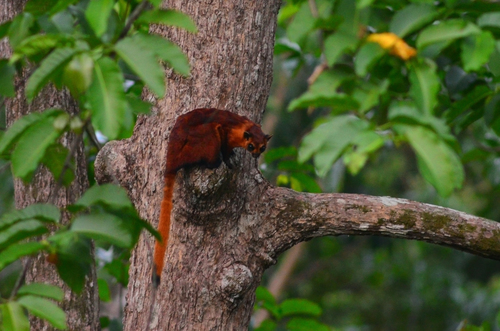
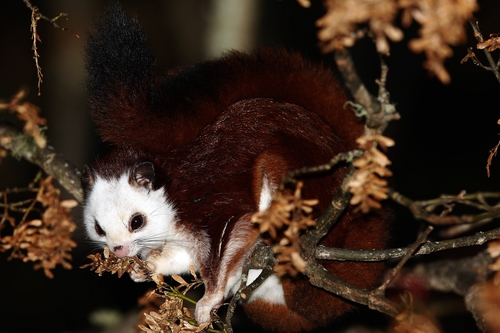
The red and white giant flying squirrel (Petaurista alborufus) is a rodent species belonging to the Sciuridae family. This is a very large flying squirrel with dark rufous-red, buff, and white coloring. It inhabits forests at altitudes ranging from 800 to 3,500 m (2,600 to 11,500 ft) in mainland China, and from 1,200 to 3,750 m (3,940 to 12,300 ft) in Taiwan. The Taiwanese population is distinct, and it is widely considered better classified as a separate species called the Taiwan giant flying squirrel, with the scientific name Petaurista lena. The red and white giant flying squirrel may also occur in northeastern South Asia and the far northern part of Mainland Southeast Asia. This species has a wide distribution and is relatively common, so the International Union for Conservation of Nature has listed it as a species of least concern. Red and white giant flying squirrels sleep in tree hollows during the day, and emerge at night to forage in trees. Their diet is primarily made up of nuts and fruits, but it also includes leafy vegetation, insects, and insect larvae. Like other flying squirrels, this species glides between trees rather than achieving true flight like bats, and has been recorded gliding up to an exceptional 400 m (1,300 ft). Gliding is made possible by the patagium, a stretch of skin that extends between the squirrel's limbs. Multiple subspecies of the red and white giant flying squirrel are recognized. Under the traditional classification, four subspecies occur in China: P. a. alborufus in Gansu, Shaanxi, and western Sichuan; P. a. castaneus in Chongqing, Guizhou, Hubei, Hunan, eastern Sichuan, Shaanxi, and Yunnan; P. a. leucocephalus in Xizang; and P. a. ochraspis in Guangxi and Yunnan. The Taiwanese subspecies is P. a. lena. However, existing records of the species from Gansu and Qinghai are likely misidentifications of Chinese giant flying squirrels. The species' status outside of China is not well understood. One source has recorded P. a. leucocephalus in northern Myanmar (Burma), while another source has recorded P. a. ochraspis there. Despite the species being confirmed in areas of China directly adjacent to northern Myanmar, its presence in Myanmar itself remains unconfirmed. P. a. leucocephalus has also been reported from Bhutan and Assam, India, but other authorities do not recognize the species as occurring in either location. Genetic studies confirm that the isolated Taiwanese P. a. lena has a unique appearance and is more closely related to several other giant flying squirrel species than it is to mainland China's red and white giant flying squirrel. For this reason, authorities recommend that it be recognized as a separate species, P. lena (the Taiwan giant flying squirrel). Another subspecies, candidula from Myanmar and northern Thailand, is typically classified as part of the red giant flying squirrel, but it may be more appropriately included in the red and white giant flying squirrel instead.