About Petasites pyrenaicus (L.) G.López
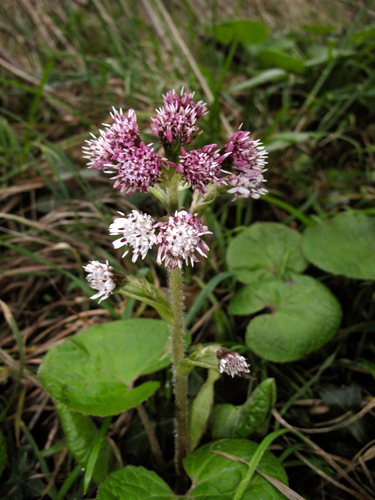
This is a description of the perennial plant Petasites pyrenaicus (L.) G.López. This species grows from deep rhizomes. It produces large, stalked, suborbicular leaves that can reach up to 20 cm across, and the leaf edges have small, regular teeth. Petasites pyrenaicus is dioecious, meaning male and female flowers grow on separate individual plants. Its erect flower heads grow in short racemes on stems that reach up to 25 cm long, and the stems have a small number of scale-leaves. The florets are pinkish-mauve, have a vanilla-like scent, and bloom at different times across the British Isles: they appear in December in Ireland, and from January to March in Great Britain. Other Petasites species found in Ireland and Great Britain are Petasites hybridus (L.) P.Gaertner, B. Meyer & Scherb, Petasites albus (L.) Gaertner, and Petasites japonicus (Siebold & Zucc.) Maxim. Petasites pyrenaicus is native to the Mediterranean region of Europe, including Italy, Sicily, and Sardinia, as well as north Africa. It was introduced to Great Britain in 1806, where it later became naturalized; it was recorded growing in the wild in Middlesex by at least 1835. It has also been introduced and become naturalized in Ireland. No female plants of this species have been recorded in the British Isles. In this region, male plants are grown ornamentally in gardens and some churchyards, and were already well established by the start of the 20th century. Ecologically, Petasites pyrenaicus is commonly found growing on shady roadside banks. Its underground rhizomes let it spread easily, and its large leaves can block sunlight from crowding out other native plants. It is classified as an invasive plant, but can be controlled through cultivation or application of weedkiller.