About Pertusaria texana Müll.Arg.
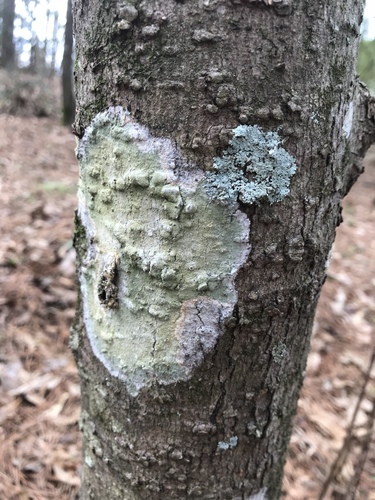
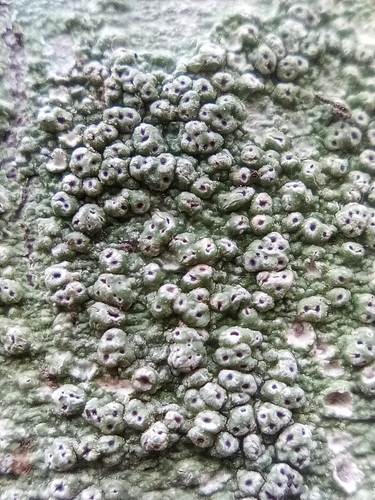
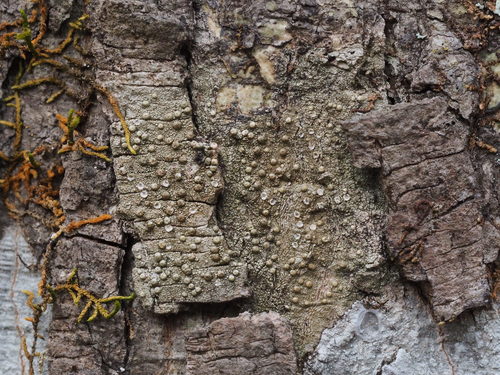
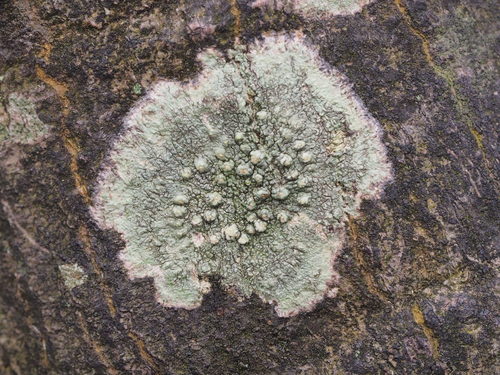
Pertusaria texana Müll.Arg. is a lichen species with a yellowish thallus (body), poriform apothecia (fruiting bodies), and wart-like verrucae projections. Its small pore-like ostiole openings have yellow papillae at their tips. Each spore-containing ascus holds eight smooth-walled ascospores. This species produces multiple secondary metabolites: stictic acid and thiophaninic acid are the major substances, while constictic acid, 2-chloro-6-O-methylnorlichexanthone, and 4-chloro-6-O-methylnorlichexanthone are minor substances. Pertusaria texana is easily confused with Pertusaria xanthodes, which shares similar chemical compounds but differs in three key traits: P. xanthodes has clear hyaline ostioles instead of yellow ones, two-spored asci instead of eight-spored, and rough-walled ascospores instead of smooth-walled. Another rare lookalike, the Florida species Pertusaria epixanthoa, differs from P. texana by having depressed rather than raised ostioles, and contains variolaric acid instead of stictic acid. Pertusaria texana is a corticolous bark-dwelling lichen that grows on a range of tree species, including Acacia, Jatropha, and Quercus (oak). It grows at elevations between 100 and 1,200 m (330–3,940 ft), and has been documented in Mexico and the southwestern United States.