About Persoonia longifolia R.Br.
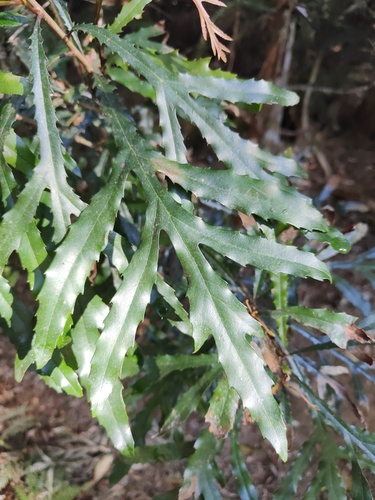
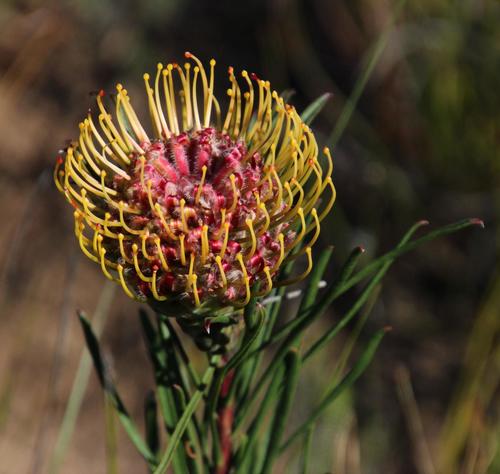
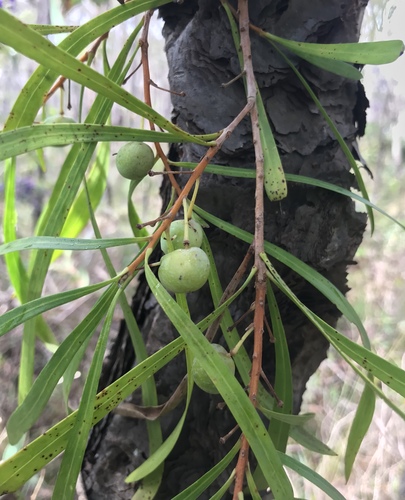
Persoonia longifolia R.Br. is an erect shrub or small tree that typically grows to a height of 1–5 m (3 ft 3 in – 16 ft 5 in), and usually has a single main trunk. It bears flaky-papery bark that is brown or greyish on the surface and reddish purple below. Young branchlets are covered with brown to rust-coloured hairs. The leaves are linear to lance-shaped with the narrower end towards the base, 80–200 mm (3.1–7.9 in) long and 2–16 mm (0.079–0.630 in) wide. Flowers are borne in groups of up to thirty on stalks up to 70 mm (2.8 in) long near the ends of branches. Each flower grows on a pedicel 4–12 mm (0.16–0.47 in) long, and has yellow tepals 10–16 mm (0.39–0.63 in) long. Flowering occurs from October to January, and the fruit is a smooth drupe 7.5–10 mm (0.30–0.39 in) long and 6–7.5 mm (0.24–0.30 in) wide that starts maturing in July and contains a single seed. This species, commonly called snottygobble, is distributed in the southwest of Western Australia within 70 km (43 mi) of the coast between Albany and the southeastern edges of Perth, and occurs in jarrah, karri, marri and tingle forest. Ecologically, Persoonia longifolia resprouts from both epicormic buds and the lignotuber after fire, often several months later. A phenology study of this species concluded that it grows, flowers and sets fruit in summer. Young branches are often damaged by larvae of the tip-boring Ptyssoptera moth, and by birds including the red-tailed black cockatoo (Calyptorhynchus banksii) and Australian ringneck parrot (Barnardius zonarius). Flowering starts in October and finishes by January, with peak flowering in November and December. The only pollinators observed in the study were native bees and the introduced honey-bee (Apis mellifera). Mature fruit falls from the plant between late July and September, and is often eaten by wallabies, kangaroos and the bobtail skink (Tiliqua rugosa). If left untouched by animals, the fleshy part of the fruit either rots or shrivels and dries. Germination takes place in late winter to early spring from fruits produced in the previous season, and microclimate appears to be an important factor affecting germination rate. Even when germination occurs, few seedlings survive, with most dying from desiccation or grazing. In terms of uses, in addition to being used for minesite restoration, P. longifolia is used in the cut-flower trade, valued for its weeping appearance and durability. It also has potential in the nursery trade for its symmetrical habit, weeping foliage and textured, flaky bark, but studies suggest that at least eighteen months of soil burial is required for seed germination.