About Persoonia lanceolata Andrews
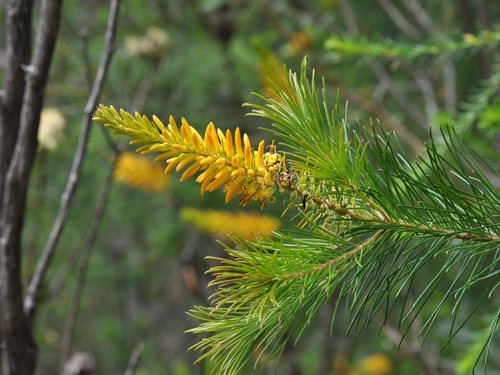
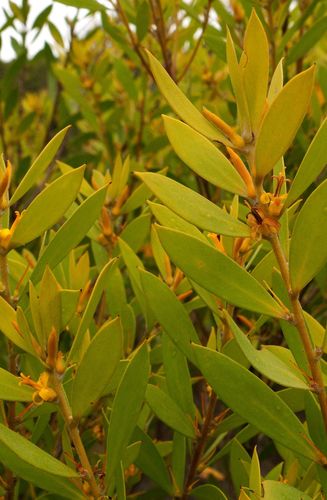
Persoonia lanceolata Andrews is a shrub that grows 0.5–3 m (1.6–9.8 ft) high. It has smooth grey bark, and new growth is covered in hairs. Its thick leathery leaves are arranged alternately along stems, are oblanceolate or obovate in shape, and measure 3–10 cm (1.2–3.9 in) long and 0.4–3.2 cm (0.16–1.3 in) wide. Leaves are hairy when young, becoming smooth and featureless as they mature. They are bright green, sometimes with a yellowish tint, and concolorous, meaning both leaf surfaces share the same colour. Finely hairy yellow flowers bloom mainly from January to April, though they can appear at any time of year. The flowers are arranged in leafy racemes, with each stem bearing 4 to 54 flowers. The species is auxotelic, meaning each stalk holds a single flower, with a leaf growing at the stalk’s junction with the stem. Flowers grow on 0.5 cm (0.2 in) stalks, reach up to 1 cm (0.4 in) in size, and are typical of the Persoonia genus. Each individual flower has a cylindrical perianth that splits into four segments called tepals, and contains both male and female reproductive parts. Inside the perianth, the central style is surrounded by the anther, which splits into four segments that curl back and look like a cross when viewed from above. These segments create a landing area for insects visiting the stigma, which sits at the tip of the style. The fruit are smooth fleshy drupes: roughly round, green, and measuring 1 cm (0.4 in) by 0.8 cm (0.3 in) in diameter. They contain two seeds, weigh around 1.3 g (0.05 oz), turn partly red as they ripen, and fall to the ground the following spring (September to October). After falling, the drupes soften and turn dark red over two to three weeks, before shrivelling and turning black. The drupes are edible, and were historically eaten by local Aboriginal people. P. lanceolata can be confused with P. levis, but can be distinguished by its firm bark and lanceolate leaves; P. levis has flaky bark and asymmetrical leaves. This species occurs along coastal and near-coastal areas of New South Wales east of the Great Dividing Range, stretching from Trial Bay on the Mid North Coast to Sassafras Morton National Park in the south. It grows in dry sclerophyll forest and heathland on low-nutrient sandstone-based soils, most often on ridge tops and slopes. Individuals growing in more sheltered areas are usually taller than those growing in more exposed locations. It occurs from sea level up to 700 m (2,300 ft) in altitude, and in the Sydney Basin, it grows in areas that receive 900–1,400 mm (35–55 in) of annual rainfall. The species is considered adequately protected in the Sydney region, and can be found in Bouddi, Brisbane Water, Marramarra, Ku-ring-gai Chase, Lane Cove, Sydney Harbour and Botany Bay National Parks. In heathland habitats, it grows alongside Banksia ericifolia, B. oblongifolia and Darwinia fascicularis. In more forested areas, it grows as an understory shrub with Lambertia formosa, Leptospermum trinervium, Daviesia corymbosa, Banksia serrata and B. ericifolia, underneath larger trees including Eucalyptus sclerophylla, E. piperita, E. sieberi, E. sparsifolia, E. punctata and Corymbia gummifera. The swamp wallaby (Wallabia bicolor) feeds on the fallen fruit of P. lanceolata and disperses the plant’s seeds through its scat. A field study in Ku-ring-gai Chase National Park found 88% of seeds in swamp wallaby scat remained viable, though dormant. The red-necked wallaby (Macropus rufogriseus) also feeds on the drupes and is considered a likely seed dispersal agent. Animals can carry seeds one or two kilometres away from the original feeding site. Rodents such as the bush rat (Rattus fuscipes) and black rat (Rattus rattus) eat the drupes but chew the seeds, so only seed fragments pass through their digestive systems. Foxes have been recorded eating the fruit, and it is thought that kangaroos and large birds such as currawongs also consume it. Colletid bees of the genus Leioproctus, subgenus Cladocerapis, forage exclusively on Persoonia flowers and pollinate many Persoonia species. Bees of the subgenus Filiglossa in the same genus also feed only on Persoonia flowers, but do not appear to be effective pollinators. Recorded bee species visiting P. lanceolata include the longtongue bees Leioproctus (Cladocerapis) carinatifrons, L. incanescens, L. speculiferus, as well as Leioproctus filamentosa and Exoneura species. The European honeybee (Apis mellifera) is a common visitor to P. lanceolata flowers, though its effectiveness as a pollinator is unclear. P. lanceolata is an obligate outcrosser, meaning its flowers require pollen from other individual plants to be pollinated. Unlike native bees, which move between different individual plants, honeybees tend to forage more on different flowers of the same plant. The abundance of honeybees may be negatively impacting the pollination success of native bees for this and other Persoonia species. Infection by the fungal species Anthracostroma persooniae and Camarosporula persooniae causes leaf spot disease in P. lanceolata. When P. lanceolata shrubs are destroyed by bushfire, the population regenerates from seedlings that survive via a soil seedbank. The Ku-ring-gai Chase study found seedlings germinated within two years of a 1994 bushfire, though some germinated up to six years after the fire, and germination was not tied to any particular season. Plants take six years to reach maturity, so more frequent bushfires prevent new recruitment and endanger populations. However, plants in Lane Cove National Park were recorded maturing just three years after an especially intense bushfire. What triggers germination in this species remains unknown, and seedlings have also grown in areas disturbed by sand mining, sometimes in higher concentrations than before the disturbance. The natural lifespan of P. lanceolata ranges from 25 to 60 years. Persoonia lanceolata is rarely cultivated, mainly due to propagation difficulties: seed germination is unpredictable, and growing plants from cuttings has proven very difficult. Even so, its bright green foliage is considered an attractive horticultural feature. To grow in gardens, it requires well drained sandy soil and a position in full sun or part shade. Once established, it tolerates moderate frosts and dry periods, and grows fairly readily in suitable conditions. Plantsmen in England successfully germinated P. lanceolata seed in 1791. On the Beecroft Peninsula, indigenous people ate the drupes of P. lanceolata, and preferred them over the drupes of P. laurina.