About Persicaria minor (Huds.) Opiz
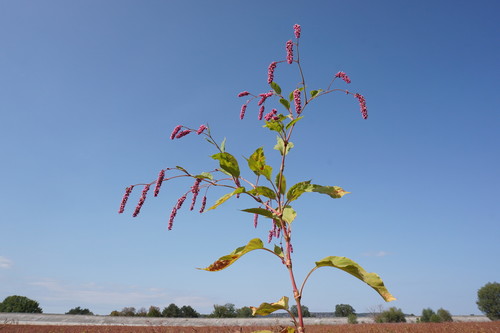
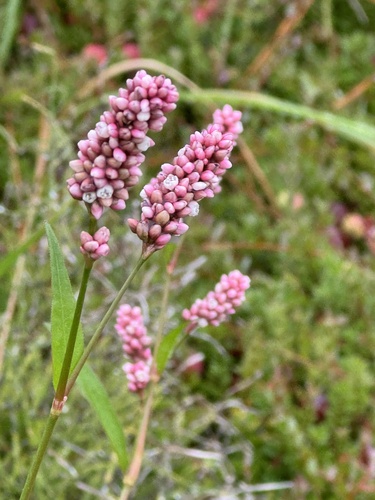
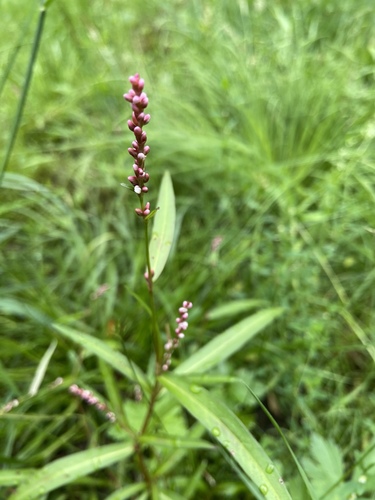
Persicaria minor (Huds.) Opiz is native to Southeast Asia, including Malaysia, Thailand, Vietnam, and Indonesia. It grows wild in cooler highlands, and can also be found in wet lowland areas near rivers, ditches, and canals. It is a creeping plant with slender stems that grows upright to a height of 1 to 1.5 meters. Its creeping stems are green with a reddish tinge, cylindrical in shape, and have short nodes spaced approximately 9 mm apart. Its leaves are long and narrowly tapering, arranged alternately, green, and attached to short, reddish petioles. Its flowers are minute, pale violet, and borne in clusters 12 to 15 cm long.
Persicaria minor is an edible, aromatic herb. In Malaysia and Indonesia, it is commonly called "kesum", where its shoots and young leaves are eaten raw as part of ulam (traditional salad), used as an aromatic spice addition to peppery dishes such as laksa, nasi kerabu, asam pedas, and tom yam, used to make tea, and applied topically in traditional medicine. Its oil has been used for aromatherapy and in treatments for dandruff. In Malaysian traditional medicine, P. minor is used in post-natal tonics and to treat digestive issues.
Pharmacological studies on P. minor have identified antioxidant activity, inhibition of LDL oxidation, anti-inflammatory, antimicrobial, digestive-enhancing, anti-ulcer, cognitive-enhancing, and immunomodulating activities, plus acetylcholinesterase-inhibiting activity. It has also been tested as a microbial inhibitor to prevent food spoilage. Comparative studies have analyzed the metabolite content of the plant's leaves, stems, and roots. Clinical studies have investigated the plant's reported ability to improve cognition, mood, stress response, and memory. When compared to four other Malaysian herbs (Cosmos caudatus, Piper sarmentosum, Centella asiatica, Syzygium polyanthum), Persicaria minor had the highest phenol concentration and the highest antioxidant activity. It has been used as a bioactive component in edible food packaging films, which use semi-refined carrageenan and glycerol as plasticizers.