About Persicaria hydropiper (L.) Spach
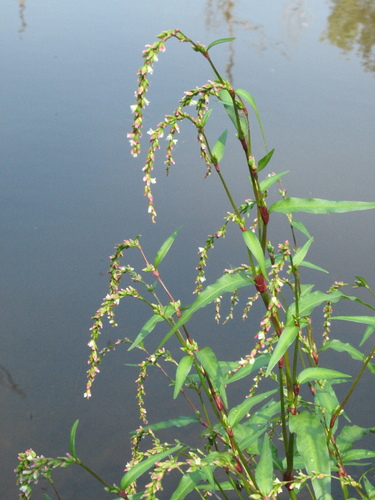
Persicaria hydropiper, commonly called water pepper, is an annual herb. It has an erect stem that reaches 20 to 70 cm (8 to 28 in) in height. Its leaves are arranged alternately and are almost stalkless. The leaf blades are narrowly ovate with entire margins fringed by very short hairs, tapering to a blunt apex. Each leaf base has stipules that are fused into a loose sheath that encloses the stem and is fringed at the upper end. Its inflorescence is a nodding spike. Each tiny flower has a perianth made of four or five segments, united near the green base, with white or pink edges. Each flower has six stamens, three fused carpels, and three styles. Its fruit is a dark brown, oval, flattened nut. Water pepper is an annual plant that grows best in damp environments. It grows readily in riparian zones on the banks of streams and rivers, and can also grow in other locations where water collects, including canal banks, tyre and hoof tracks in woodlands, waterlogged soil, and around field gates. It tolerates partial shade and base-poor soil. It is native to the United Kingdom, where it can grow at any altitude from sea level up to 505 metres. Water pepper is eaten in Japan, where it is called tade (蓼), or more specifically yanagi tade (柳蓼). Leaves of cultivated plants are used as a vegetable, as wild water pepper has a much more pungent taste. This herb is usually sold in markets as seedlings. Young red sprouts, called beni-tade (紅蓼), are used to garnish sashimi, tempura, and sushi, and it is popular for summer cooking. Its seeds may also be added to wasabi. A traditional Japanese sauce called tade-zu (蓼酢), or water pepper sauce, is made from finely chopped water pepper leaves soaked in vinegar with a small amount of steamed rice; occasionally, squeezed kabosu juice is added. In Japanese cuisine, it is traditionally served as a complement to grilled freshwater fish, but not saltwater fish. In China, water pepper is known as là liǎo (辣蓼) or shuǐ liǎo (水蓼), and is used in traditional Chinese medicine. In Indian traditional medicine, leaves of P. hydropiper are used to treat intestinal helminth infections. One published study has confirmed that P. hydropiper leaves have notable anthelmintic efficacy, justifying their traditional use against intestinal worms, with study identifier DOI: 10.1007/s12639-022-01559-2. In Europe, water pepper was once cultivated and eaten during wartime as a substitute for pepper. This plant contains many acids, including formic acid, which makes it unpalatable to livestock. While mammals do not eat wild water pepper, some insect species do. This has inspired the Japanese saying "Tade kuu mushi mo sukizuki" (蓼食う虫も好き好き), which translates to "Some insects eat water pepper and like it," and is equivalent to the English sayings "There is no accounting for taste" or "Each to his own."