About Persicaria decipiens (R.Br.) K.L.Wilson
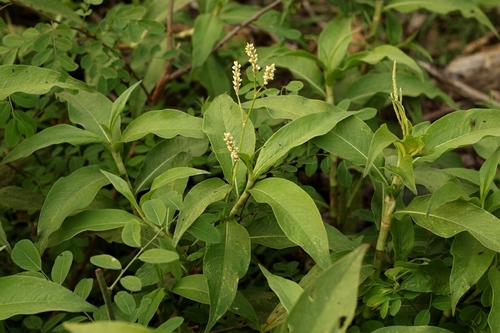
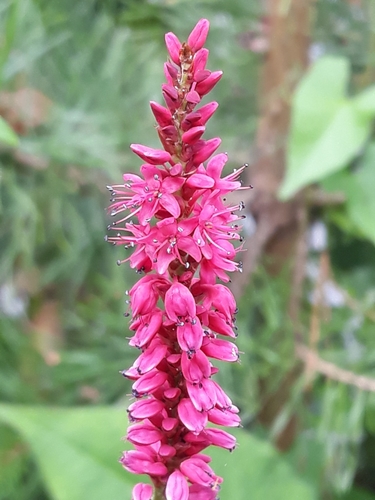
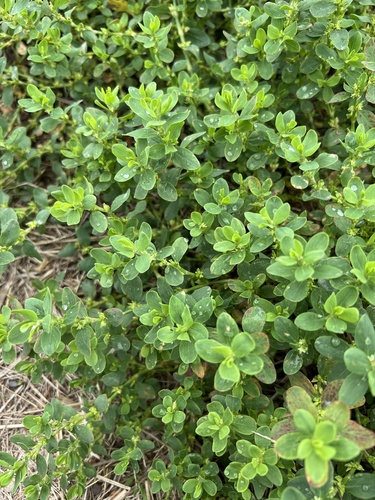
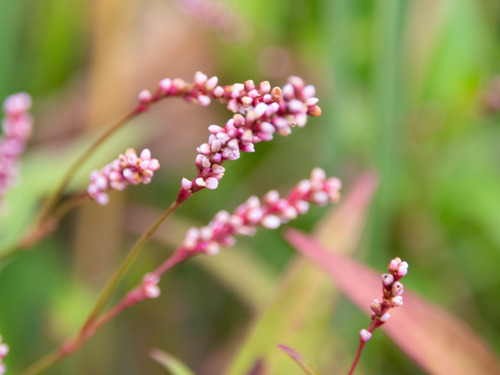
Persicaria decipiens, commonly called slender knotweed, is a species of flowering plant native to Australia and Asia. It is a trailing plant: its stems initially grow horizontally, then become more vertical over time, reaching 30 centimetres (1 foot) in height. Its leaves are narrow, ranging from elliptic to lanceolate (spear-shaped), and measure 5–12 cm (2–4.5 in) long by 0.5–1.3 cm (0.20–0.51 in) wide. Slender pink cylindrical flower spikes appear from November to June, with peak blooming in February. The flower spikes are not stiff and tend to bend over. This plant typically dies back in winter and regenerates after water exposure.
Persicaria decipiens was collected by Joseph Banks and Daniel Solander on 5 May 1770 at Botany Bay, during Captain James Cook's first voyage. Prominent Scottish botanist Robert Brown first described the species as Polygonum decipiens in his 1810 work Prodromus Florae Novae Hollandiae et Insulae Van Diemen. Karen Wilson gave the species its current accepted name Persicaria decipiens (R.Br.) K.L.Wilson in 1988, when the broadly defined genus Polygonum was split into smaller genera. Additional common names for this species include willow weed and snake root.
P. decipiens grows in water and wet soil. Its distribution spans Africa, the Mediterranean, southwestern Asia, Malesia, all states of Australia, Norfolk Island, New Zealand, and New Caledonia. It has become naturalised in Madagascar. Its flowers are likely pollinated by insects, including honeybees, native bees, flies, wasps, and small butterflies. Persicaria decipiens is not cultivated, but is eaten locally during periods of famine in Africa.