About Persea palustris (Raf.) Sarg.
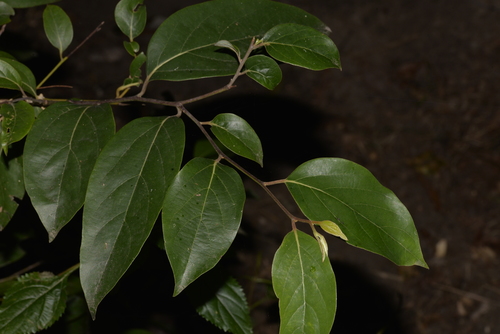
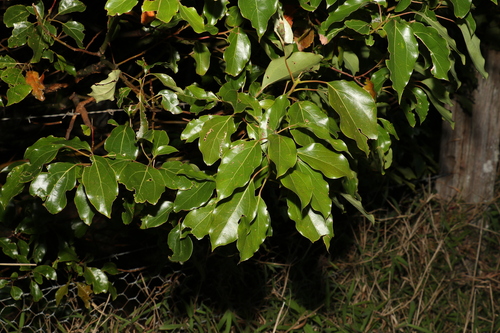
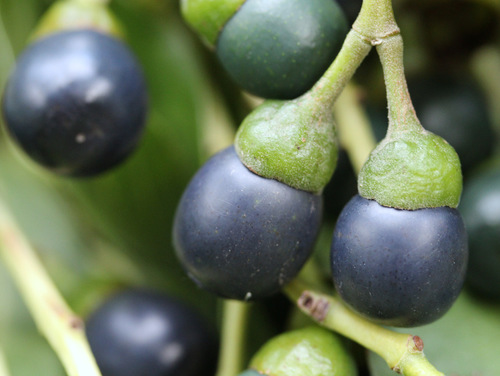
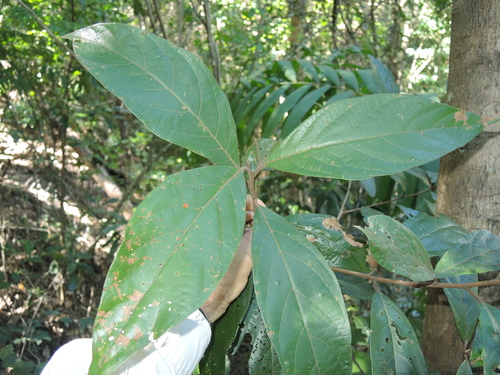
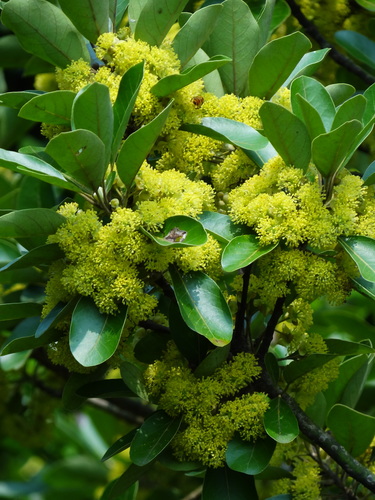
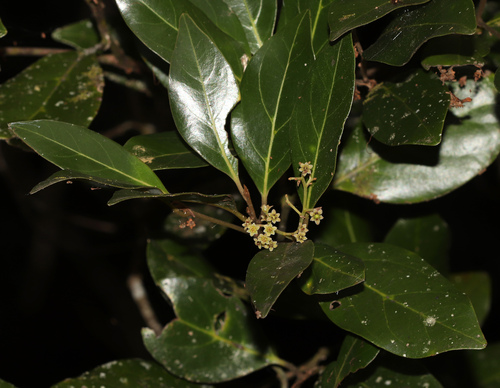
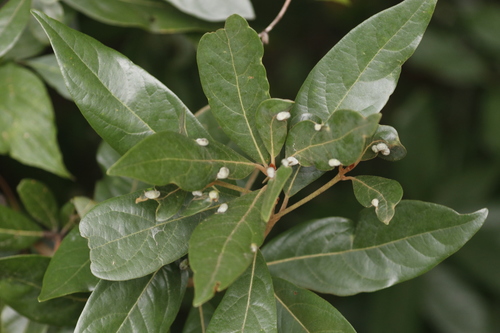
Persea palustris (Raf.) Sarg., also referred to as Tamala palustris, can grow as a slender tree reaching 30 to 40 feet (9 to 12 meters) in height, with a trunk usually under 1 foot (0.3 meters) in diameter. More often, however, it grows as a shrub with stems 12 to 15 feet (3.7 to 4.6 meters) tall. Its dull brown bark is typically no more than 0.25 inches (6.4 millimeters) thick, and its surface is split into separate scales by fissures. The plant has stout branches; when young, branches are circular in cross-section (terete) and slightly angled. For the first two growing seasons, branches are covered in a layer of rust-colored tomentum, which becomes much sparser after this period and disappears entirely after two to three years. Leaves are either lanceolate or long-elliptic, with medium to dark green upper surfaces and paler lower surfaces covered in distinct brownish hairs. Leaves measure 2–8 inches (5–20 centimeters) in length. The small flowers are bisexual, meaning they have both male and female reproductive structures. Each flower has 6 tepals, 9 pollen-producing stamens, one pistil containing the female reproductive parts, and 2–3 petals; flowers are yellow-green, and bloom in May and June. The fruit is a small drupe, a single seed surrounded by fleshy tissue, that is oblong or rounded, and about 0.4 inches (1 centimeter) long. The dense, reddish brown hairy coating on its leaves and branches easily sets this species apart from its close relatives Tamala humilis and Tamala borbonia. This species is distributed across the Southeastern United States and the Bahamas, occurring in eleven U.S. states ranging from Delaware to Southeast Texas. Its range overlaps extensively with that of Tamala borbonia. It is common throughout all of Florida, including the Florida Keys, and is also common in coastal plain regions of North Carolina. Its natural habitats include swamps, bays, pocosins, coastal swales, and maritime forests, and it grows particularly well in wet, peaty soil, though it can also grow in dry, sandy soil.