About Persea borbonia (L.) Spreng.
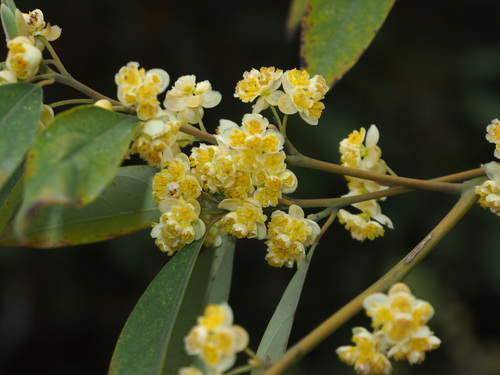
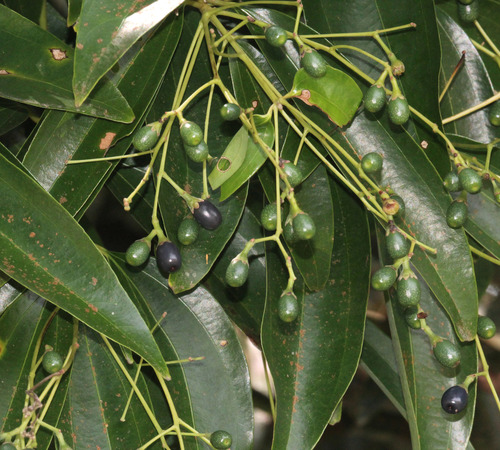
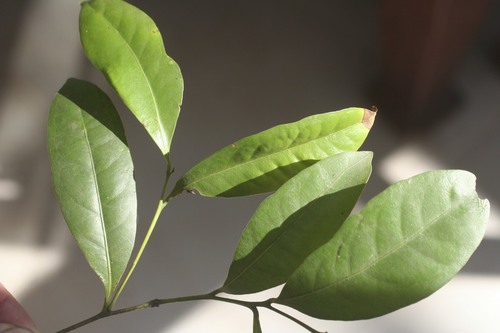
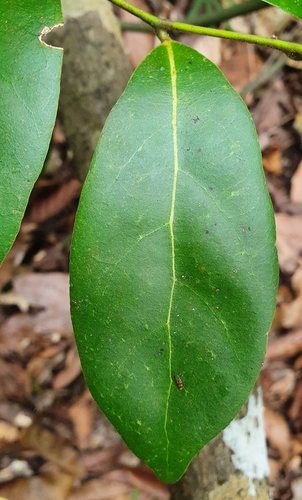
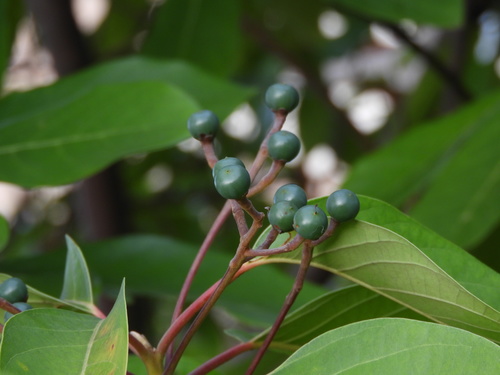
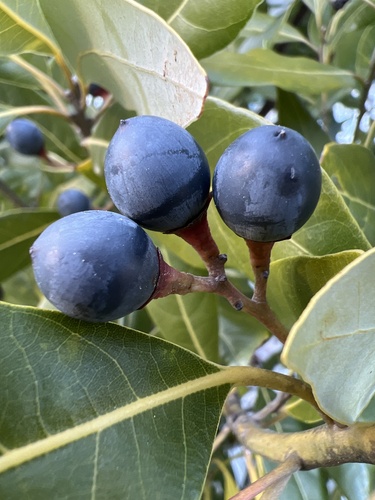
Persea borbonia (also referred to as Tamala borbonia, commonly called redbay) can grow as a small tree or a large shrub. It is an evergreen perennial with a lignified non-herbaceous stem, and can live for 80 to 100 years. Its leaves are arranged alternately, are lance-shaped, 3 to 6 inches long, range in color from bright green to dark green, and emit a spicy scent when crushed. It produces small, blue or black drupe fruits. This species is native to coastal margins of the southeastern United States and the Bahamas. In the United States, it grows in the lowlands of Texas, Arkansas, Louisiana, Florida, Mississippi, Alabama, Georgia, South Carolina, and eastern North Carolina; small isolated populations also grow in coastal Virginia, and near the Maryland and Delaware state line. It also occurs naturally in the Bahamas, and is cultivated in Hawaii. It typically grows on the borders of swampland. Since the 2002 discovery of an invasive redbay ambrosia beetle population near Savannah, Georgia that carries the laurel wilt fungal pathogen, widespread redbay death has occurred across the southern United States. Foresters agree the species will likely not go extinct in the southeastern U.S., because it appears able to rejuvenate on its own to some degree. The plant is not widely used for medicinal purposes today, but the Seminole tribe formerly used it as an emetic to induce vomiting. Dried leaves of the species can be used as a condiment. Its hard, strong wood is used for boat construction, cabinet making, and interior lining of structures, but is not traded commercially at a large scale, so use is confined to regions where the species grows. Persea borbonia is cultivated as an ornamental tree for gardens and parks.