About Persea americana Mill.
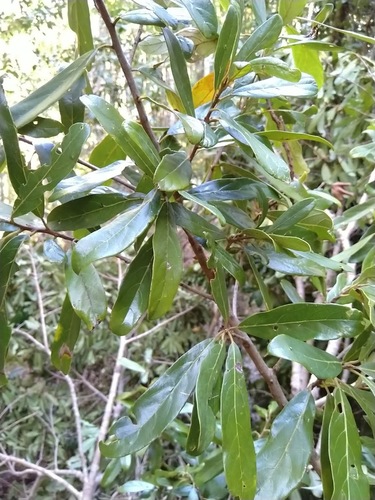
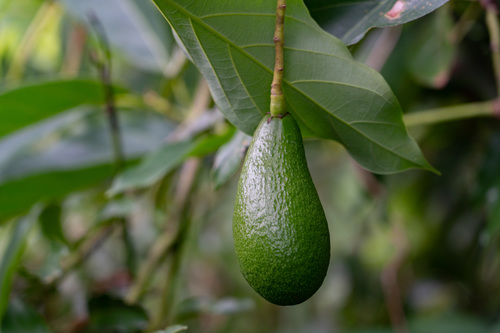
Persea americana Mill., commonly known as avocado, is a tree that reaches 9–20 m (30–66 ft) in height, with a trunk diameter between 0.3–0.6 m (1–2 ft). Its leaves grow 8–25 cm (3–10 in) long and are arranged alternately along branches. Avocado leaves, bark, skin, and pit are documented to be harmful to many animals, including cats, dogs, cattle, goats, rabbits, rats, guinea pigs, birds, fish, and horses, which can be severely harmed or killed when they consume these plant parts. The avocado fruit is poisonous to some birds, and the American Society for the Prevention of Cruelty to Animals (ASPCA) lists avocado as toxic to horses. Avocado leaves contain persin, a toxic fatty acid derivative. In sufficient quantities, persin causes colic in horses, which can lead to death without veterinary treatment. Symptoms of persin poisoning include gastrointestinal irritation, vomiting, diarrhea, respiratory distress, congestion, fluid accumulation around heart tissues, and death. Birds are also particularly sensitive to this toxic compound. Leaves of the Guatemalan variety of P. americana are specifically toxic to goats, sheep, and horses. It was traditionally believed that domestication of the avocado, which produced genetically distinct cultivars, originated in the Tehuacan Valley in Puebla, Mexico. However, archaeological findings show much earlier human interaction with the fruit than previously thought. The oldest known avocado remains were discovered at Huaca Prieta, a preceramic site on Peru’s northern coast, where humans were consuming avocados as early as 10,500 years ago. This predates the previously considered oldest avocado pit discovery: pits found in Coxcatlan Cave, dating to around 9,000 to 10,000 years ago. Other caves in the Tehuacan Valley from around the same time period also show early evidence of avocado presence and consumption. Along with early archaeological evidence from Peru, genetic and linguistic research has identified three major domesticated avocado landraces: Guatemalan (quilaoacatl), Mexican (aoacatl), and West Indian (tlacacolaocatl). These landraces developed in separate ecological regions of Mesoamerica and Central America: the Guatemalan and Mexican landraces originated in the highlands of their respective countries, while the West Indian landrace is a lowland variety ranging from Guatemala, Costa Rica, Colombia, and Ecuador to Peru. Human activity spread the West Indian landrace across this wide range before Europeans arrived. The three separate landraces most likely already intermingled in pre-Columbian America, and were described in the Florentine Codex. Millennia before the Columbian exchange, artificial selection led to cultivated avocados having considerably larger fruit and corresponding seeds than their earlier wild ancestors. The earliest residents of northern coastal Peru lived in temporary camps in an ancient wetland and ate avocados alongside chilies, mollusks, sharks, birds, and sea lions. Additional evidence of avocado use exists at Norte Chico civilization sites at Caballo Muerto, Peru, dating to around 3,800 to 4,500 years ago. Avocado trees have a long history of cultivation in Central and South America that is now known to be much older than originally thought. A water jar shaped like an avocado, dating to AD 900, was discovered in the pre-Inca city of Chan Chan. The plant was introduced to Spain in 1601, Indonesia around 1750, Mauritius in 1780, Brazil in 1809, the United States mainland in 1825, South Africa and Australia in the late 19th century, and the Ottoman Empire in 1908. In the United States, avocados were introduced to Florida and Hawaii in 1833, and to California in 1856. The name "avocado" has been used in English since at least 1764, with minor spelling variants such as avogato attested even earlier. Until 1915, avocados were commonly called ahuacate in California and alligator pear in Florida. That year, the California Avocado Association popularized the term avocado. Mexico is by far the world's largest avocado growing country, producing several times more than the second largest producer. In 2013, the total area dedicated to avocado production in Mexico was 188,723 hectares (466,340 acres), and 2017 harvests reached 2.03 million tonnes. The states with the highest production are México, Morelos, Nayarit, Puebla, and Michoacan, which together account for 86% of Mexico’s total avocado production. In Michoacán, cultivation is complicated by drug cartels that extort protection fees from cultivators. Cartels are reported to exact 2,000 Mexican pesos per hectare from avocado farmers, and 1 to 3 pesos per kilogram of harvested fruit. This issue has led to the term "blood guacamole" being adopted to describe the social effects of vast global demand for avocados in Mexico. Avocados were introduced to California from Nicaragua in the early 1850s, when imported avocado trees were observed growing near San Gabriel. Avocado has since become a successful cash crop in the state. As of 2015, about 24,000 hectares (59,000 acres) of avocado cultivation is located in Southern California, representing around 80% of total United States avocado production. Avocado is the official state fruit of California. Fallbrook, California, claims the title of "Avocado Capital of the World" without official recognition, a title also claimed by the Mexican town of Uruapan. Both Fallbrook and Carpinteria, California host annual avocado festivals. The California Avocado Commission and the California Avocado Society are the two major grower organizations in the state, and Calavo Growers is a major distributor. Hass avocado production in Peru covers thousands of hectares in central and western Peru. Peru is now the largest supplier of avocados imported to the European Union, and the second largest supplier to Asia and the United States. Peru’s location near the equator and along the Pacific Ocean creates consistently mild temperatures year-round. Peruvian Hass avocados are seasonally available to consumers from May through September, and are promoted by the Peruvian Avocado Commission, which is headquartered in Washington, D.C. Chile has produced avocados for over 100 years, with production increasing dramatically in the early 1980s due to rising global demand. In 2015, New York magazine reported that large avocado growers in Chile are draining the country's groundwater and rivers faster than these sources can replenish themselves. 88% of Chile’s total avocado production, and 99% of its exported avocados, are Hass avocados. Avocados are a staple fruit in Chile, with 30% of production destined for the domestic market. Due to free trade agreements, China, the United States, and the European Union impose no import tariffs on Chilean avocados.