About Peromyscus boylii (Baird, 1855)
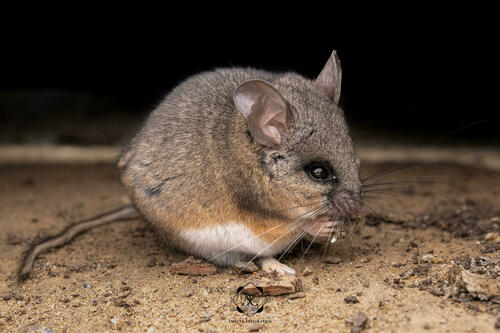
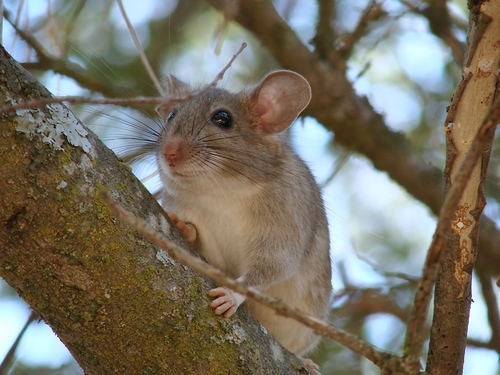
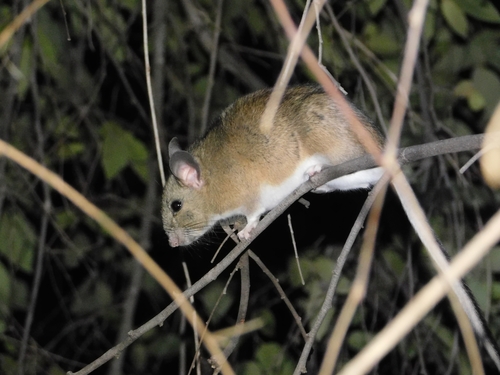
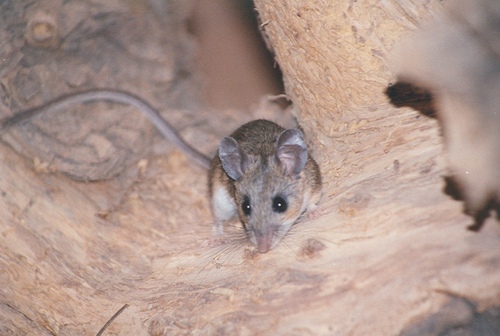
Description The brush mouse (Peromyscus boylii) is a medium-sized mouse with small ears and a long tail. It has yellowish-brown fur on its body and slate grey fur on its underparts. For most of its length, the tail has only sparse hair, but it ends in a distinct brush-like tuft of hair. It should be noted that the common name may more likely derive from the brushy environment this species inhabits, rather than the tail tuft. The brush mouse has a head-body length of 86 to 105 mm (3.4 to 4.1 in), and a tail that ranges from 88 to 115 mm (3.5 to 4.5 in) in length. It is very similar in appearance to a number of closely related mouse species that share the same geographic range, but can be distinguished from these species by traits including tail length, ear size, and the presence of the distinct tuft at the end of the tail.
Distribution and habitat The brush mouse is found from northern California to eastern Colorado and western Texas in the United States, and extends south to Baja California and southern Mexico. Fossils of brush mice dating up to 35,000 years old have been discovered, and none have been definitively identified from outside the species' current range. While the vegetation of brush mouse habitats varies across locations, the species is consistently found in areas with medium to high densities of shrubs and tree cover that are under 16 ft (4.9 m) in height. In California, mature chaparral (with 50% or greater vegetation cover) appears to provide more suitable habitat for brush mice than young, open chaparral (with less than 50% cover). Similarly, in Arizona, Duran captured brush mice most frequently in shrub live oak and birchleaf mountain-mahogany (Cercocarpus betuloides) understory habitats that have 45% to 50% plant cover. Fewer brush mice were captured in habitats with lower plant cover. Holbrook observed that after vegetation crowns were removed in a manzanita (Arctostaphylos spp.)-oak shrubland, brush mice avoided the newly opened space. In another study, brush mice were strongly restricted to habitats where gaps between rocks or ceanothus (Ceanothus spp.) on the site were less than 4 ft (1.2 m).
In addition to shrub density, the height of vegetation cover appears to influence brush mouse distribution within a site. Brush mice preferred an average understory height of 5.0–6.5 feet (1.5–2.0 metres) over lower understory cover. In another study, brush mouse presence was positively correlated with microhabitats of shrub cover up to 10 feet (3.0 m) tall, logs over 3 inches (7.6 cm) in diameter, and understory trees 10–33 feet (3.0–10.1 metres) in height, but negatively correlated with grass-forb microhabitats. Brush mice are also commonly captured at locations with high proportions of rock cover and/or slash piles, across habitats including chaparral-mountain shrub, oak/shrub, oak-juniper-pinyon pine, juniper-pinyon pine, and oak-pine communities, as well as riparian habitats. In Texas, the brush mouse has been found in all major habitats present there: desert, grassland, riparian, and montane, though it is typically associated with rock outcrops within these habitats. Riparian sites with abundant brush mouse populations had high shrub cover and a high frequency of debris piles, with low grass, litter, and tree cover. In a study in Mexico, brush mice occurred in a canyon dominated by exposed rock, grasses, pines, hardwoods, and brush. In West Texas, brush mice favor fallen logs and brush piles. Modi discovered that brush mice are common in riparian zones dominated by pecan (Carya illinoensis), American sycamore (Platanus occidentalis) and live oak (Quercus virginiana), in an oak community with a partially open canopy and dense understory, and in a pine forest with little understory and scattered boulders. In New Mexico, brush mouse populations were significantly (P<0.05) higher on sites that were bulldozed or thinned (98 and 115 captures, respectively) than on untreated or bulldozed and burned sites. Populations were lowest on sites that had not been treated (45 captures). Sites that had increased slash from bulldozing and burning had more brush mice (57 captures) than untreated sites, but this difference was not significant (P>0.05). Severson et al. observed no influence of canopy cover on brush mice.
Besides high tree, shrub, and rock densities, brush mice appear to prefer locations with low grass cover. At the same time, grasses are often present in the understory of their habitats, indicating that grasses do not completely exclude brush mice. Brush mice use both grazed and ungrazed pastures as well as ceanothus plots, but they are concentrated around rocky outcrops and vegetation continuous with these rock outcrops. No brush mice were captured in grasslands located more than 20 ft (6.1 m) from rocks, shrubs, or trees. Litter depth also appears to be negatively correlated with brush mouse presence. For example, brush mice in Arizona were captured in litter depths of only 0.9 inches (2.3 cm).
Brush mice also use fire-affected habitats. In one study, brush mice were captured in burned and unburned chaparral, as well as burned and unburned pine-oak forest. The highest number of captures was recorded in unburned forest, while the lowest number of captures occurred in unburned chaparral. These results are somewhat inconsistent with other observations that the brush mouse favors dense chaparral habitat. Small mammal capture data for this study was collected from 14 months to three years after fire, and the time frame of sampling after fire may influence the perceived response of the brush mouse to burned habitats.
Elevation, in addition to habitat characteristics, may play a role in habitat suitability in some areas. For example, in the northern Sierra Nevada of California, brush mice were captured in brush habitats at 3,500–5,000 ft (1,100–1,500 m), but not at 6,500 ft (2,000 m). Aspect may also influence the distribution of brush mice on a site. For example, in New Mexico, 51% of all captured brush mice were taken on south-facing slopes, 24% on west-facing slopes, with 13% and 12% captured on east- and north-facing slopes, respectively. South-facing canyon slopes may provide more cover for brush mice due to higher numbers of shrubs. Although brush mice are found on a variety of slopes, including flat mesas and gradual slopes, they seem to prefer locations with very steep slopes such as hillsides, mountainsides, and canyons (including some slopes with >45% gradient) over more gradual slopes in the same areas. Findley reported that brush mice were captured on hillsides in an oak/sacahuista (Nolina spp.) community. In another study, brush mice were common in canyon bottoms, on hillsides, and in arroyos (water channels in arid regions) characterized by oak woodlands. Brush mice have also been captured along the sides of brush covered canyons and burned slopes of an oak/brush association.
Density and home range In coastal California, brush mouse population densities have been recorded as 40–72 mice per hectare, and another study in the region found densities of 42–89 mice per hectare. Densities appear to be greatly influenced by weather. One year, densities were 17–20 per acre, but were reduced to six mice per acre following a severe winter. At another study site, brush mouse densities increased from four individuals per acre to 12 per acre after a mild winter. Populations in a canyon in Mexico were estimated to have a mean of 10.8 brush mice per acre, made up of 6.0 males and 4.8 females per acre, with a range of 9–14 brush mice per acre. A study using radiotelemetry and trapping data in Arizona estimated the mean home range size for male brush mice at 0.72–1.6 acres (0.29–0.65 hectares), and 0.32–0.79 acres (0.13–0.32 hectares) for females. In another study at the same location, mean home ranges for male brush mice ranged from 1.2–1.5 acres (0.49–0.61 ha) and for females, mean home ranges were 0.64–1.2 acres (0.26–0.49 ha). Based on radiotelemetry, the overall mean home range for male and female brush mice in Arizona was 0.30 acres (0.12 ha).
Food habits Brush mice are semiarboreal, and can be found foraging in shrubs and trees for leaves and fruits. Females were captured more often than males foraging in canyon live oaks (Q. chrysolepis). Individuals with longer tails appear to spend more time climbing than those with shorter tails. Acorns are commonly eaten by brush mice wherever acorns are available. Arthropods and cutworms (Protorthodes rufula) are also eaten throughout the year. A variety of fruits and seeds from Douglas-fir, ponderosa pine (Pinus ponderosa), pinyon, California buckeye, manzanita (A. patula and A. viscida), silktassel (Garrya spp.), oneseed juniper (Juniperus monosperma), hackberries (Celtis spp.), New Mexico groundsel (Senecio neomexicanus var. neomexicanus), trailing fleabane (Erigeron flagellaris), annual sunflower (Helianthus annuus), broom snakeweed, common dandelion (Taraxacum officinale), western yarrow (Achillea millefolium), white sweetclover (Melilotus albus), threenerve goldenrod (Solidago velutina), prickly-pear, desert wheatgrass (Agropyron desertorum), Kentucky bluegrass (Poa pratensis), and blue grama (Bouteloua gracilis) are eaten throughout the year when available. Other plant parts, such as leaves, stems, flowers, pollen cones, and new sprouts are typically eaten in lower quantities than other foods. Fungi are typically consumed when other foods are scarce. Infrequently, stomach contents of brush mice have contained pieces of mammals, birds, and fence lizards (Sceloporus spp.). Brush mice have been observed caching pinyon pine seeds. This observation suggests the brush mouse may play a role in seed dispersal for some plant species.