About Perognathus flavus Baird, 1855
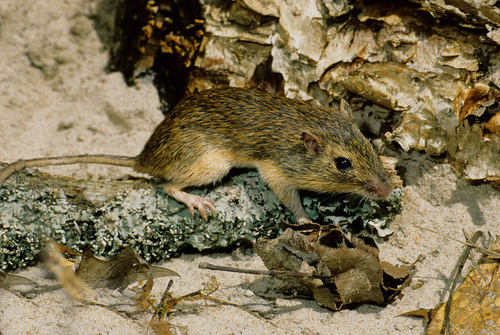
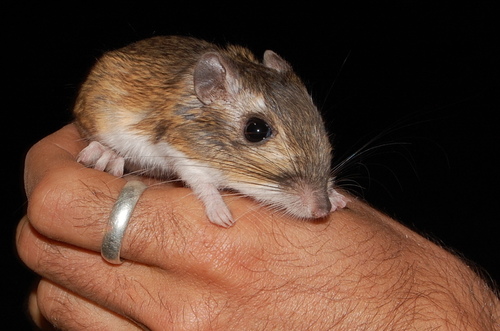
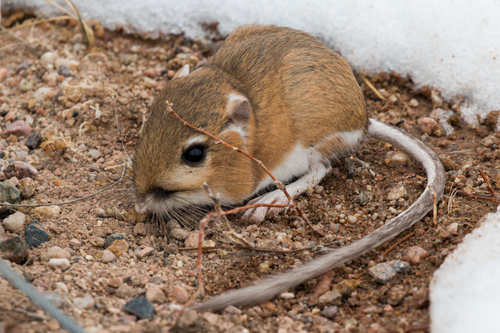
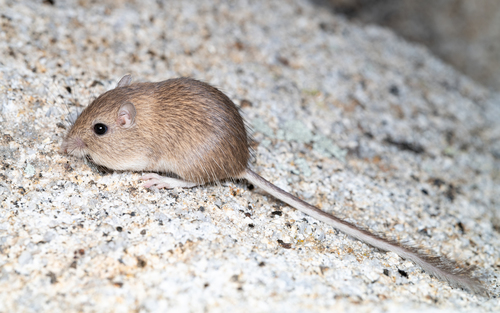
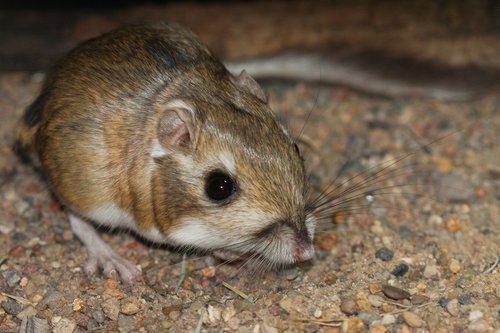
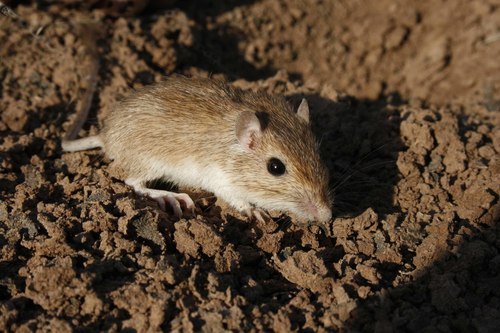
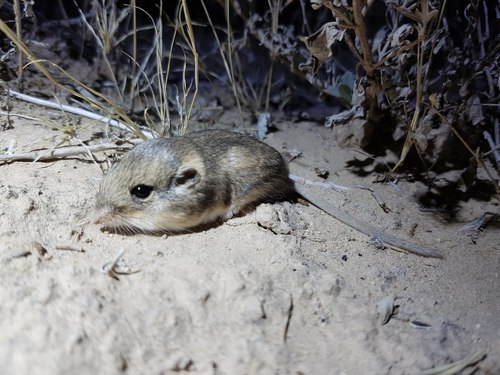
The silky pocket mouse (Perognathus flavus Baird, 1855) is the smallest pocket mouse in the family Heteromyidae, and is otherwise very similar in appearance to other members of the genus Perognathus. It has a relatively short tail, which is buff or dusky colored on the upper side and white on the underside. The tail lacks a tuft of hair at the tip, and is always shorter than the combined length of the head and body, which averages about 60 mm (2.4 in). The upper parts of the body are ochre or yellowish-buff, covered in many black-tipped hairs. The underparts and forelegs are white. There are distinct plain buff patches with no black-tipped hairs behind the ears, and a narrow strip of plain buff between the dorsal coloring and the underparts. This species shows little sexual dimorphism, but males typically have a slightly longer tail than females. The silky pocket mouse is endemic to the southern United States and Mexico. In the United States, it occurs in the states of South Dakota, Nebraska, Utah, Colorado, Kansas, Arizona, New Mexico, Texas and Oklahoma, and may have occurred in Wyoming where it is possibly now extinct. In Mexico, it is found across most of the central plateau. It inhabits arid and semiarid grassland, sandy and rocky areas, Pinus-Juniper stands, Artemisia flats, shrublands, and areas with Yucca and cactus.