About Pernis ptilorhynchus (Temminck, 1821)
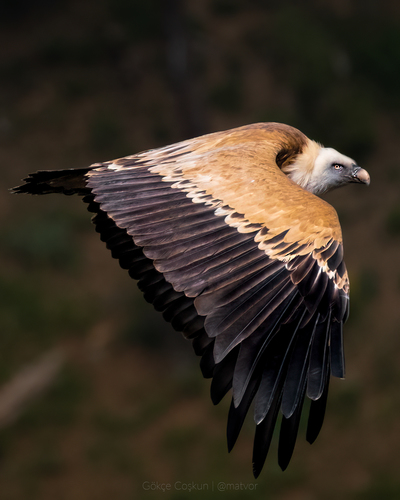
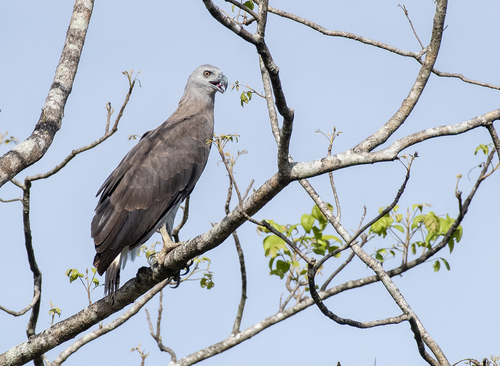
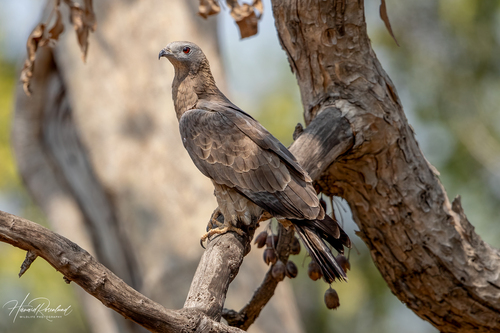
The crested honey buzzard, Pernis ptilorhynchus, measures about 57–60 cm (22–24 in) in length, making it a fairly large raptor. It lacks a prominent superciliary ridge on its head, giving it a facial appearance very different from most other raptors. It has a long neck and small head that resembles a pigeon's head, with a short head crest and a long tail. Its upperparts are brown, lighter in shade than the European honey buzzard, and its underparts are paler than its upperparts. A dark stripe runs along its throat. Unusually for a large bird of prey, males and females can be easily told apart. Males have blue-grey heads and brown irises, while females have brown heads and yellow irises, and are slightly larger and darker than males. Males have two black bands on the tail and three black bands under the wings; females have three black tail bands and four narrower black underwing bands. Juveniles have extensive black tips on their primary feathers, with narrower underwing bands. They have a yellow cere at the base of the bill, and a dark iris. Overall, the species' colouration and tail pattern are highly variable. At a distance when in flight, it can easily be mistaken for the short-toed snake-eagle, but it can be distinguished by its slimmer head and longer neck. It is most often seen soaring alone or in pairs, or perched on tree tops. It stays quiet even while nesting, and will sometimes produce a single high-pitched screaming whistle. When flying, it uses deep, elastic wing beats with high upstrokes. It glides and soars on wings held flat or slightly arched, at right angles to its body. Its long, broad wings have well-rounded tips with six 'fingers'. The tail is broad, medium length with a rounded tip, and is shorter than the combined breadth of the wing bases. For the Palearctic (Eurasian) subspecies, wingspan is 2.4 times the bird's total length; for the Indo-Malayan subspecies, this ratio is 2.0–2.2. The plumage similarity between juvenile crested honey buzzards and Nisaetus hawk-eagles is thought to have evolved as partial protection against predation by larger raptors. Hawk-eagles have stronger bills and talons, and are less likely to be targeted by large predators than species in the Pernis genus. Juvenile European honey buzzards show similar mimicry, as their plumage resembles the common buzzard. While the Eurasian Goshawk can kill both species, it is more cautious about attacking Buteo species, which are better able to defend themselves. This form of mimicry is classified as Batesian mimicry, named after English naturalist and explorer H.W. Bates, who first described this type of mimicry in moths and butterflies (Lepidoptera) in 1861. The crested honey buzzard is a summer migrant to Siberia, Korea, and Japan, and spends the winter in tropical Southeast Asia and the Indian subcontinent. Migratory individuals leave Siberia in late August and return in May. In Japan, summer migration occurs from April–May to mid-September. Populations elsewhere are largely non-migratory resident birds. Migrating crested honey buzzards that travel from breeding grounds in Japan to wintering areas in Southeast Asia cross the East China Sea. This 700 km (430 mi) nonstop overwater flight is possible because autumn winds over the sea blow in the same direction the birds are traveling, providing wind support. The species has been recorded in Europe in Italy (2011), Cyprus (2012), at the Strait of Messina, and in Lesvos, Greece (2018). It has also been recorded on Shemya, an Alaskan island; this record is the first documented occurrence of the species in North America, and the photographed individual belonged to the subspecies P. p. orientalis. The crested honey buzzard prefers well-forested lowland and hilly areas broken by open glades. In South and Southeast Asia, it is sometimes found in small groves near human villages. It occurs from sea level up to 1,500 m (4,900 ft), and occasionally as high as 1,800 m (5,900 ft). During migration, it can be found at elevations over 3,000 m (9,800 ft).