About Perna viridis (Linnaeus, 1758)
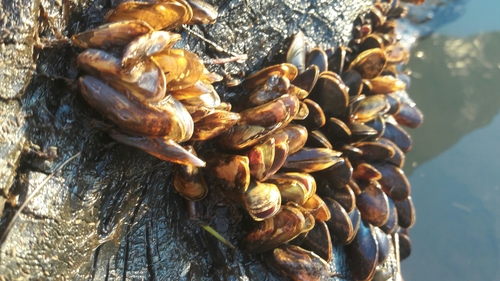
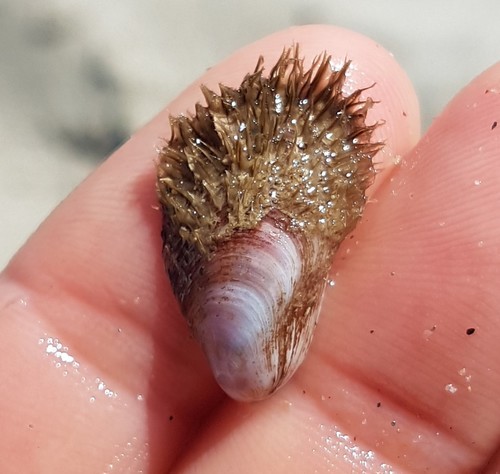
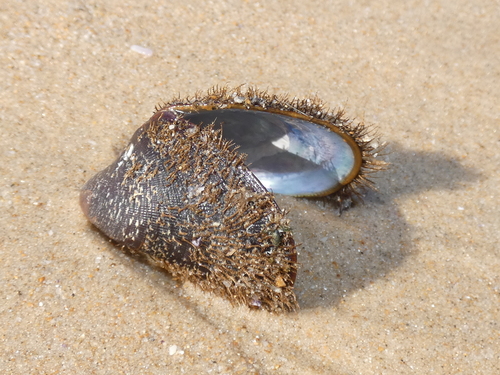
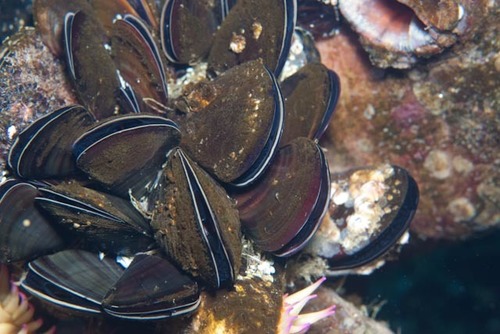
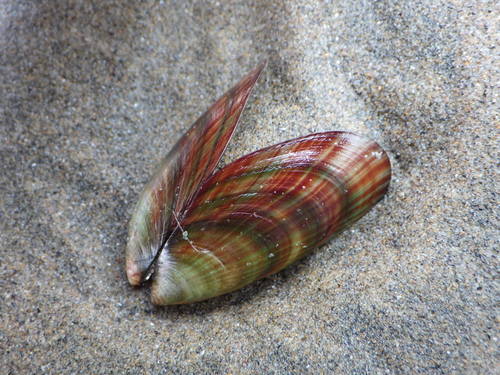
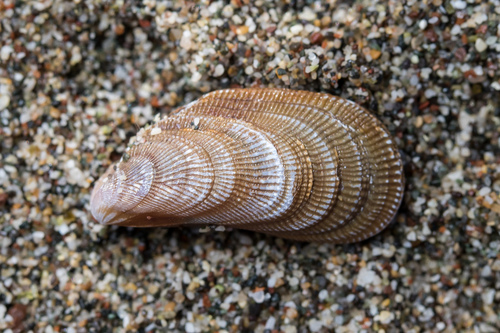
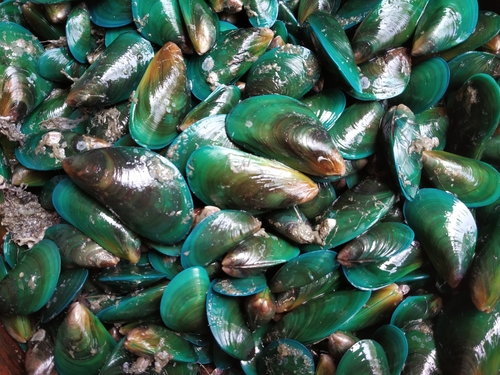
Perna viridis, commonly called the Asian green mussel, typically measures 80 to 100 millimeters (3 to 4 inches) in length, and may occasionally grow as large as 165 millimeters (6 inches). Its shell terminates in a downward-pointing beak. The smooth outer periostracum is dark green, and becomes increasingly brownish toward the umbo (the point of attachment), which is a lighter color. Young mussels are bright green, and their shell color darkens as they age. The interior of the shell has a pale-blue sheen. This mussel has a large mobile foot that it uses to climb vertically if it becomes covered by sediments. It also produces byssal threads to help it attach firmly to its substrate. Two closely related similar species are Perna canaliculus, native to New Zealand waters, and Perna perna, native to African waters. The Asian green mussel is naturally found in the coastal waters of the Indo-Pacific region. It has been introduced to other areas as an invasive species, transported via boat hulls and ship water ballasts. It inhabits estuarine habitats, and can reach densities as high as 35,000 individuals per square meter on any submerged marine object. Despite its vivid green appearance, the mussel is often covered by other marine overgrowth, making it difficult to find. It lives in waters with temperatures ranging from 11 to 32 °C (52 to 90 °F), and tolerates a wide salinity range of approximately 18 to 33 ppt. P. viridis grows fastest 2 meters (2 yards) below the water surface, in high salinity conditions with a high concentration of phytoplankton, though it can tolerate a broader range of salinities and turbid water. Asian green mussels have separate sexes, with external fertilization. Fewer than 0.1% of individuals are functional hermaphrodites. Temperature has been shown to affect the species' sexual development. Spawning usually occurs twice a year between early spring and late autumn; however, populations of the species in the Philippines and Thailand are known to spawn year-round. A zygote develops into a larva 7 to 8 hours after fertilization. Larvae remain in the water column for 10 to 12 days before undergoing metamorphosis into juvenile mussels and settling onto a hard surface. Juveniles reach sexual maturity when they grow to 15 to 30 millimeters (1/2 to 1 1/4 inches) in length, a size achieved within 2 to 3 months of settling. Growth rate is influenced by food availability, water temperature, water movement, mussel age, and caging for cultivation. Cage culturing prevents predators from accessing the mussels, and the presence of barnacles increases the mussels' marketability, but both cage culturing and barnacle presence slow the mussel's growth rate. Adult Asian green mussels can live up to 2 to 3 years. Due to its fast growth rate, P. viridis can outcompete other native fouling organisms and cause changes to existing marine ecological relationships. This mussel is a filter feeder, and consumes phytoplankton, zooplankton, and suspended organic materials. Its predators include fishes, crustaceans, seastars, octopuses, other mollusks, and humans.