About Perna perna (Linnaeus, 1758)
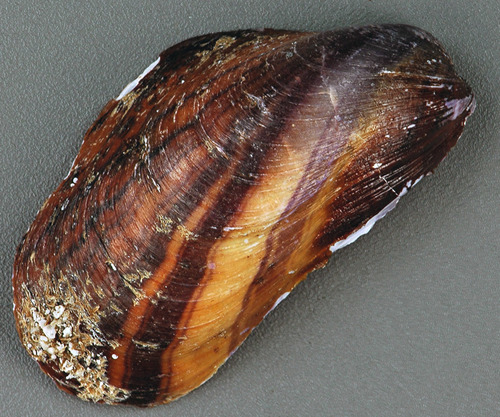
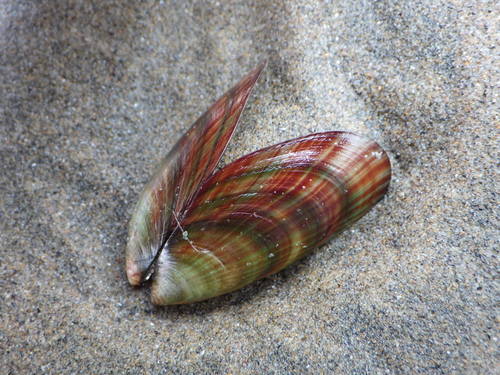
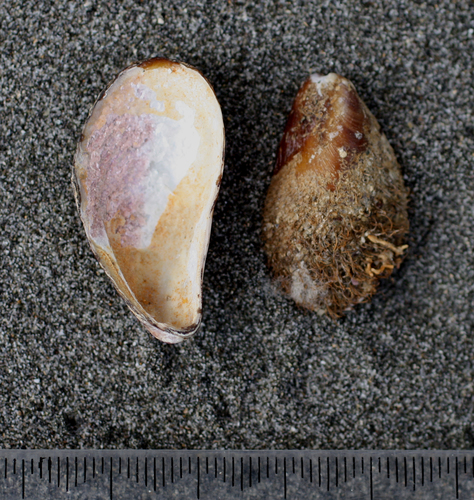
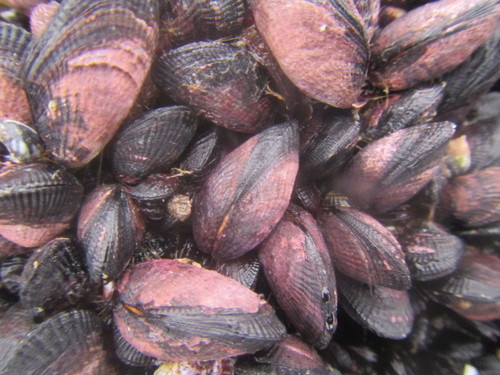
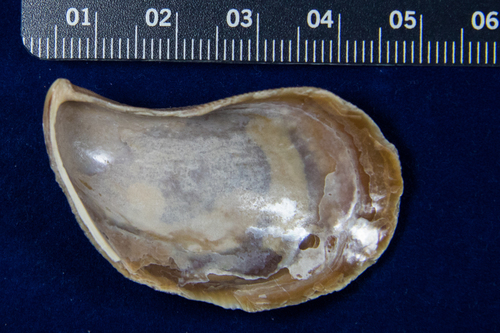
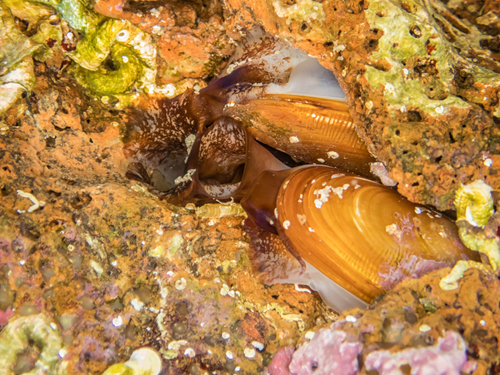
Perna perna (Linnaeus, 1758) commonly measures 90 mm in length, and can grow as large as 120 mm. This mussel has a characteristic brown color, and its key identifying trait is the divided posterior retractor mussel scar. A pitted resillal ridge also distinguishes it from other bivalves. It resembles several other mussel species. The European mussel Mytilus galloprovincialis shares a similar shape and color with Perna perna, and both occupy the native south-western African coast habitat. Mytilus galloprovincialis is more resistant to human disturbance from uses like bait and consumption, as well as more resistant to certain parasites, and it is outcompeting Perna perna. The black mussel Choromytilus meridionalis has a similar shape and size to Perna perna, but lacks the distinct pitted resillal ridge. Perna perna can also be mistaken for the better known Perna viridis, a greenish-brown species, because both species can have color and shell shape that changes with environmental conditions. The brown mussel is native to tropical and sub-tropical regions of the Atlantic Ocean and Western Indian Ocean. It occurs in waters off west Africa, the South American coast as far north as the Caribbean, and along East Africa and Madagascar. It has been accidentally introduced as an invasive species to the coast of Texas, carried to this location via boat hulls and ship water ballasts from Venezuela. Documented populations of this species are also found in Chile, Peru, and South Africa. Perna perna naturally colonizes rocky shores, and can also attach to submerged man-made structures including navigation buoys, petroleum platforms, and shipwrecks. Adult brown mussels tolerate temperatures between 10 °C and 30 °C, and salinity levels from roughly 15 to 50 ppt. When Perna perna colonizes hard surfaces, it improves the marine ecology of that surface. The colonization increases available surface area, which encourages other marine organisms including limpets, polychaetes, barnacles, snails, and algae to settle on the surface as well. Perna perna uses external fertilization during its spawning season, which runs from May to October, with spawning also reported in December. During spawning, males and females each release sperm and eggs into the water, which produce veliger larvae. Fifteen hours after fertilization, these larvae already have well-developed hinge teeth. Between 10 and 12 days after fertilization, the larvae undergo metamorphosis and begin secreting byssal threads, after which they settle on rocky surfaces. The brown mussel is a filter feeder that consumes phytoplankton, zooplankton, and suspended organic materials. It is affected by two parasites, Proctoeces maculatus and an unidentified bucephalid sporocyst, that castrate both male and female individuals. On the African coastline, predators of Perna perna include the whelk Nucella cingulata, lobsters, octopuses, gulls, and the African black oystercatcher. On the South American coastline, it is a food source for Callinectes danae, Cymatium parthenopeum, Chicoreus brevifrons, Thais haemastoma, and Menippe nodifrons.