About Periplaneta americana (Linnaeus, 1758)
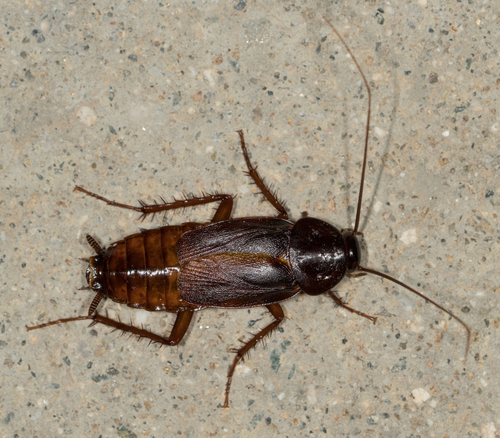
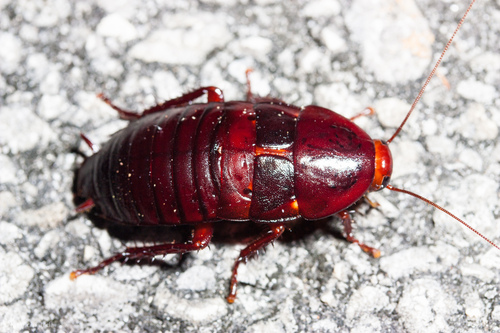
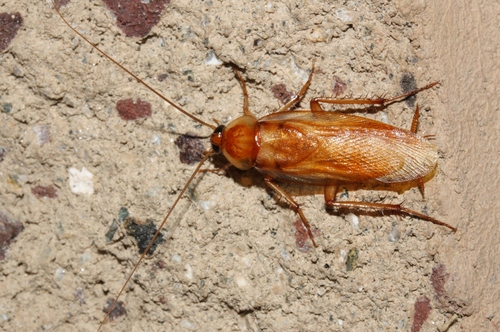
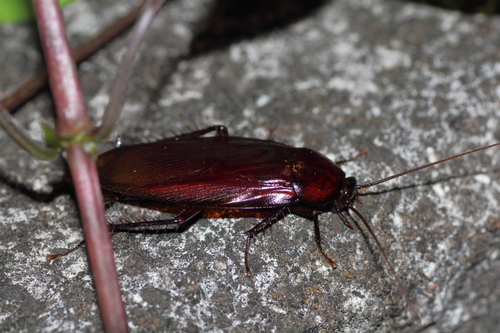
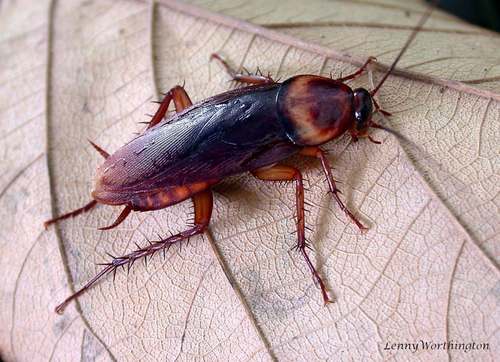
Periplaneta americana, commonly called the American cockroach, has distinct physical and behavioral traits. Among all common cockroach species, it has the largest body size, the longest life cycle that can reach up to around 700 days, and molts 6–14 times before metamorphosis, with 13 molts being the most common. Adults average around 4 cm (1.6 in) in length and about 7 mm (0.28 in) in height. They are reddish brown, with a yellowish margin on the pronotum, the plate-like body region behind the head that covers part or all of the insect thorax’s dorsal surface. Immature American cockroaches (nymphs) resemble adults, but they do not have wings. This species has a flattened, broadly oval body divided into three sections, with the shield-like pronotum covering its head. It has chewing mouthparts, long segmented antennae, leathery forewings and delicate hindwings, and a terminal abdomen. American cockroaches can travel very quickly, often darting out of sight when they sense a threat, and can fit into small cracks and under doors even with their relatively large body size; they are considered one of the fastest running insects. In one experiment, a P. americana reached a recorded speed of 5.4 km/h (3.4 mph), which equals roughly 50 body lengths per second, comparable to a human running 330 km/h (210 mph). This species has a pair of large compound eyes; each eye holds over 3,500 individual lenses called ommatidia, which are hexagonal apertures that produce mosaic vision. This form of vision has higher sensitivity but lower resolution, works particularly well at night, and is referred to as nocturnal vision. P. americana is an active nocturnal insect that avoids light. American cockroach nymphs are able to regenerate lost limbs. This species follows characteristic insect morphology: the body is divided into head, thorax (also called trunk), and abdomen. The thorax is split into three segments: prothorax, mesothorax, and metathorax. Each thoracic segment grows a pair of walking cursorial legs. American cockroaches have two pairs of wings. The forewings, called tegmina, develop from the mesothorax and are dark and opaque. The hindwings develop from the metathorax and are used for flight, though American cockroaches rarely fly. The abdomen is divided into 10 segments, each surrounded by chitinous exoskeleton plates called sclerites: these include dorsal tergites, ventral sternites, and lateral pleurites. Contrary to what its common name suggests, no species in the genus Periplaneta is native to the Americas. P. americana was introduced to what is now the United States from Africa as early as 1625. Human activity has expanded the species’ habitable range, so it is now common in tropical climates. Global commerce has made the species virtually cosmopolitan in distribution. American cockroaches typically live in moist areas, but they can survive in dry areas if they have access to water. They prefer warm temperatures around 29 °C (84 °F) and cannot tolerate low temperatures. Adults cannot survive for multiple days at temperatures of 10 °C or lower; at constant temperatures of 8 °C, 9 °C, and 10 °C, around 40% of American cockroaches died within 72 hours. This species is commonly found in basements, crawl spaces, and cracks and crevices of porches, foundations, and walkways next to buildings. In non-tropical residential areas, American cockroaches live in basements and sewers, and may move outdoors into yards during warm weather. The American cockroach life cycle has three developmental stages: egg, nymph, and adult. Females produce an egg case called an ootheca that protrudes from the tip of the abdomen. On average, females produce 9–10 oothecae, though they can sometimes produce as many as 90. After roughly two days, females place the egg cases on a surface in a protected location. Egg cases are about 0.9 cm (0.35 in) long, brown, and purse-shaped. Immature nymphs hatch from egg cases after 6–8 weeks, and require 6–12 months to reach maturity. After hatching, nymphs feed and go through a series of 13 molts (ecdysis). Adult American cockroaches can live for up to an additional year, during which females produce an average of 150 offspring. The entire American cockroach reproductive cycle can last up to 600 days. The American cockroach is used as an ingredient in traditional Chinese medicine, with references to its use recorded in the Compendium of Materia Medica and Shennong Ben Cao Jing. In China, an ethanol extract of the American cockroach known as Kāngfùxīn Yè (康复新液) is prescribed to support wound healing and tissue repair.