About Peripatoides novaezealandiae (Hutton, 1876)
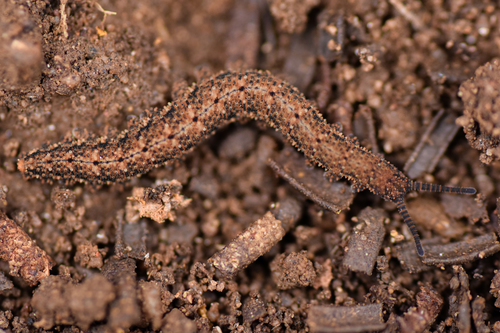
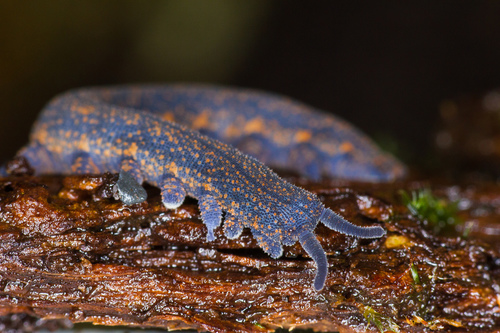
Like all velvet worms (Onychophora), Peripatoides novaezealandiae sensu stricto has a long, worm-shaped body, a head, and an anal cone. The head carries three pairs of modified limbs: antennae, jaws, and oral papillae. Its skin has a velvety texture, and the sticky slime projected from the oral papillae does not stick to this skin. The species respires through two rows of tracheae on the dorsal surface, which alternate with the legs. All members of the Peripatoides novaezealandiae species complex have 15 pairs of unjointed, hollow, cone-shaped limbs called lobopods. This feature distinguishes them from the closely related Peripatoides suteri, which has 16 pairs of lobopods. On the ventral side of the legs of the P. novaezealandiae-complex, there are three complete spinous pads and a fourth fragmented pad, and all individuals have three distal papillae on the feet. Coloration ranges from brownish red to purplish black, and a thin black dorsal stripe is usually present. A cluster of orange-coloured papillae near the eyes is a characteristic trait of the P. novaezealandiae-complex. Adult body length ranges from 2.5 to 5 cm. Males can reach a maximum weight of 200 mg, while adult female weight varies more widely, with some specimens weighing over 800 mg. Morphologically, males can usually be told apart from females by a pair of posterior orange papillae that mark the opening of the anal glands, but these papillae develop before maturity, so they cannot be used to identify only sexually mature males. Males in the P. novaezealandiae-complex lack the pheromone-producing crural glands that are present in many other Onychophora, such as Euperipatoides rowelli. Newborn P. novaezealandiae s. str. are pure white with slightly purple antennae. Other morphs in the P. novaezealandiae-complex are born with pigments, which may differentiate them from P. novaezealandiae s. str. Peripatoides novaezealandiae s. str. is endemic to New Zealand. Within New Zealand, P. novaezealandiae s. str. is restricted to the Wellington, Wairarapa, and southern Hawke's Bay regions, occurring in locations including Miller reserve, Otari, Akatarawa, Waiohine, Carterton, and Pahiatua. Peripatoides novaezealandiae s. str. is most commonly found inside or underneath rotting logs. Sufficient moisture is essential for all Onychophora, because they cannot regulate water loss, as they lack both a waxy cuticle and tracheal spiracles. Like all members of the P. novaezealandiae-complex, P. novaezealandiae s. str. reproduces via lecithotrophic viviparity, meaning embryos are surrounded by egg membranes and get their nutrition from yolk while developing inside the ovary, and hatching and birth happen at the same time. Juveniles go through three distinct developmental stages. In Stage A, the outer tissue (integument) is wet and shiny, and the needle-like spines of sensory papillae are exposed. In Stage B, which occurs up to nine days after birth, the integument becomes more strongly pigmented, loses its shine, and the sensory spines remain partially exposed. In Stage C, the integument is fully pigmented, has no shine, the sensory spines are no longer exposed, and the papillae match the adult form. The time taken to reach Stage C varies substantially by location and morph, which suggests there may be diagnostic differences between subspecies of the P. novaezealandiae-complex. Peripatids grow by moulting their outer cuticle when it becomes too small. P. novaezealandiae s. str. is an iteroparous batch breeder, meaning it produces young in separate, discontinuous batches. Males of P. novaezealandiae s. str. reach sexual maturity when they weigh between 40 and 60 mg, while females reach sexual maturity at between 80 and 95 mg body weight. Females carrying embryos usually weigh between 114 and 508 mg, but can grow as large as 800 mg. Before the development of the first embryos, the paired uteri of females are white and thin. After first embryo development, the uteri of all mature females are thick-walled, yellow, and baggy. Females can store sperm in spermathecae, potentially for more than two years. Dissections show that both males and females contain sperm in every month of the year. In some Onychophora, male spermatophores (sperm-containing capsules) attach to the female's integument; sperm then invade the haemolymph (body cavity) and travel to the reproductive tract. No spermatophores or corresponding attachment scars have been found on female P. novaezealandiae-complex individuals, but sperm has been found within their haemolymph. This evidence suggests sperm transfer in this species is dermal-haemocoelic (through the skin into the body cavity), but this has not yet been confirmed.