About Periophthalmus barbarus (Linnaeus, 1766)
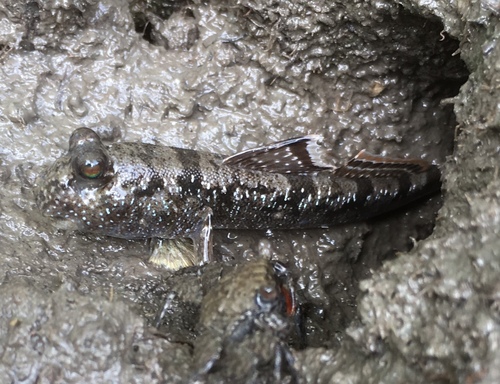
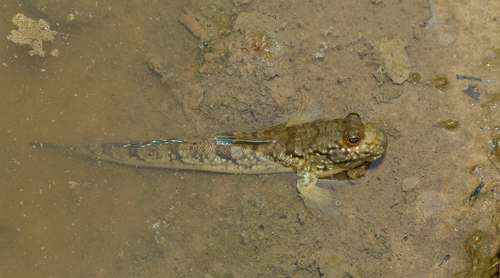
Anatomy and morphology of the Atlantic mudskipper (Periophthalmus barbarus): this species can grow up to 16 cm in total length. Its body is covered in scales, and coated in a mucus layer that helps retain moisture. There are more than 90 scales along the side of the body. In addition to retaining moisture via mucus, Atlantic mudskippers store water in their gill chambers, which allows them to breathe when they are out of water. Unlike many fish, Atlantic mudskippers do not have a membrane covering their gill chambers, and can actively control the opening and closing of these chambers. This control is achieved either through the muscles surrounding the gill slits, or through differences in partial pressure. Besides breathing via stored water in the gills, the Atlantic mudskipper can also breathe through its skin, a process called cutaneous respiration. Atlantic mudskippers have one pair of pectoral fins that allow them to 'skip' across land and maintain stability in water. They also have one pair of caudal fins that help with aquatic locomotion, and pelvic fins that assist the pectoral fins during movement on land. The pelvic fins are adapted for terrestrial life: they act as a sucker to attach the mudskipper to land surfaces. With their pelvic and pectoral fins, Atlantic mudskippers can crawl and climb on land. The eyes of the Atlantic mudskipper are adapted for terrestrial living: they are positioned close together, which gives the mudskipper a large field of vision. Each eye can move independently of the other, with a full 360 degrees of movement. The eyes are also positioned higher up on the head, so they can stay above the water surface even when the rest of the body is submerged. Beneath each eye there is a cup-like structure that holds water, which lubricates the eyes when the mudskipper is on land. When on land, Atlantic mudskippers perform a whole-body rolling behavior: during this behavior, the eyes are retracted, and the dermal cup structures cover them, so the dermal cup membrane comes into contact with fluids from the surface the mudskipper is rolling on. After the roll is complete, the eyes extend back out and the dermal cups recede. This rolling behavior likely captures water in the eye cups and across the body for lubrication, which is supported by laboratory observations that the mudskippers roll much more frequently when exposed to higher air flow (which causes higher evaporation rates). The Atlantic mudskipper has chemosensory receptors located inside its nose and on the surface of its skin. It can rotate its mouth opening to orient its jaws over prey. Its mouth holds sharp teeth, which reflect the species' carnivorous diet. Atlantic mudskippers have a short digestive system, made up of an oesophagus, stomach, intestine, and rectum. Historically, the stomach was not recorded in this species because it is not well defined unless its internal structures are examined microscopically. The internal surface of the intestine is folded, which increases the surface area to enhance nutrient absorption. The Atlantic mudskipper has a unique olfactory organ: this includes a 0.3mm-diameter canal near the upper lip that widens into a chamber-like sac. These chamber-like sacs only serve a mechanical function: they circulate water through the canals, which are the actual sensory structures. On the abdomen, Atlantic mudskippers have genital papillae. Females can be distinguished from males by their papillae, as males have less rounded papillae. Distribution: Atlantic mudskippers are found across West Africa, in mangrove swamps and primarily brackish coastal water bodies. Documented countries where the species occurs include Angola, the Democratic Republic of the Congo, Cameroon, and Ghana. The distribution of Atlantic mudskippers within these regions is shaped by the availability of food and shelter. It may also be affected by the species' hibernation behavior. Habitat: Atlantic mudskippers are semi-aquatic animals that live in slightly salty water habitats, such as river estuaries and mudflats. In general, Atlantic mudskippers spend most of the day on land. In tidal areas, Atlantic mudskippers only come out to feed during low tide; at high tide, they hide inside their burrows. Their burrows can reach 1.5 metres deep, and the mudskippers use them to escape from predators. Burrows may hold a pocket of air that the Atlantic mudskipper can breathe from, even when the surrounding water has low oxygen availability. The Atlantic mudskipper is generally tolerant of high concentrations of toxic industrial waste compounds, including cyanide and ammonia, in its environment. For example, when exposed to high levels of ammonia contamination, the Atlantic mudskipper can actively secrete ammonia through its gills in highly acidic environments. It can also survive in a wide range of environments, including waters with varying temperatures and salinity levels. Hot, humid climates are optimal for Atlantic mudskippers, as they improve cutaneous respiration and help the mudskippers maintain their body temperature. The body temperature of Atlantic mudskippers on land can range from 14 to 35 degrees Celsius. Atlantic mudskippers are territorial, and build walls of mud around their territory and the resources within it. A territory is approximately 1 metre long, and supports healthy mudskipper populations by storing food resources. Reproduction: Females reach sexual maturity at a body length of around 10.2 cm, while males reach sexual maturity at approximately 10.8 cm. Atlantic mudskippers can spawn year-round, though peak spawning occurs from February to May for males and from March to May for females. These peak spawning periods align with high food availability for the species' young. Fertility in Atlantic mudskippers increases with body length, as larger females can carry more eggs. Females lay thousands of eggs at one time, but the eggs are very vulnerable to predation. Mudskippers flood their burrows to trigger eggs to hatch. Only a small proportion of offspring survive, as they are highly susceptible to predation. During courtship, after a male pairs with a female mudskipper, both individuals enter the male's burrow to mate. After the female releases her eggs onto the burrow wall, the male provides a large amount of paternal care. The male Atlantic mudskipper guards and takes care of the eggs inside the burrow.