About Periophthalmodon schlosseri (Pallas, 1770)
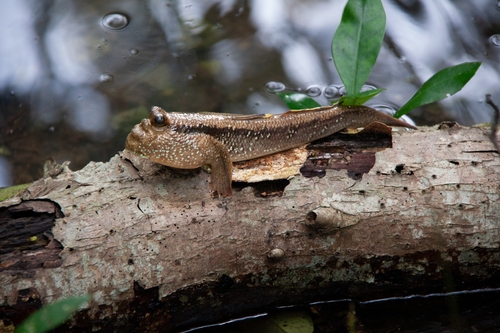
Periophthalmodon schlosseri, commonly known as the giant mudskipper, is a species of mudskipper native to tropical shores of the eastern Indian Ocean and western Pacific Ocean. It occurs in marine, brackish, and fresh waters, and is most often found along muddy estuary shores and river tidal zones. The species constructs burrows in the higher ground of the intertidal zone; these burrows typically hold both water and air. During warmer seasons, giant mudskippers are usually active outside their burrows when the tide is low. This species is an obligate air-breather, and can drown if it does not have sufficient access to air, so it spends most of its life on land. As its common name suggests, the giant mudskipper is set apart from other mudskipper species by its larger size. Males have been recorded reaching a maximum total length of 27.5 cm (10.8 in), while females can grow up to 28.5 cm (11.2 in) in total length. The species is typically yellow or greenish-brown with light blue speckles along its sides, but when disturbed or agitated, it displays a bold, solid black horizontal stripe that runs from its eye all the way to its caudal peduncle. The giant mudskipper has minor importance to local commercial fisheries. In addition to being sold at high prices as food, this and other mudskipper species are also used in traditional medicine in Malaysia and parts of India. The giant mudskipper inhabits intertidal mudflats and mangroves in Eastern India, Thailand, Malaysia, Singapore, Indonesia, and Vietnam. While it is more commonly found in areas near mangroves, it can sometimes also live on mudflats with no nearby mangroves. Spawning for the giant mudskipper usually happens twice each year: first from June to July, and a second time from October to November. This spawning schedule is linked to the monsoon season, which runs from April to October and provides the species with abundant access to food. Giant mudskippers are a monogamous species. Besides using burrows for protection and rest, males dig burrows to attract a single female. After mating, females lay eggs on the roof or walls of the burrow. The water held in these burrows is severely hypoxic, which makes it unsuitable for embryonic development. To supply oxygen to the developing brood, males continuously refresh the air inside the burrow during low tide: they fill their mouths with air and release it into the burrow. Once a female has laid her eggs, she is driven out of the burrow, and the male acts as the sole caretaker for the brood. The expelled female usually stays near the water's edge after leaving the burrow.