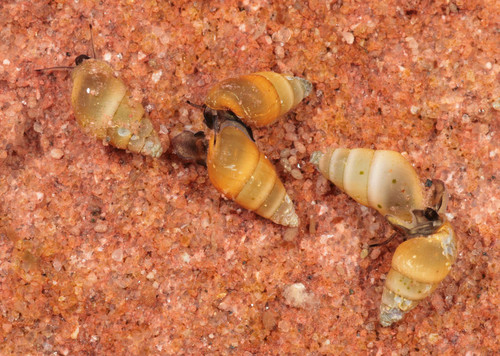
About Peringia ulvae (Pennant, 1777)
Peringia ulvae was originally described by Welsh naturalist Thomas Pennant in 1777. Pennant’s original type description reads: "Ulvae. T. with four spires, the first ventricose; of a deep brown color; aperture oval. Size of a grain of wheat. Tab. lxxxvi. fig. 120. Inhabits Ulva Lactuca on the shores of Flintshire." In this description, the abbreviation "T." stands for the Latin word testa, meaning "shell". The shell of this species is often heavily corroded, typically whitish with a brown peristome on the last whorl. It has 5–7 very weakly convex whorls that increase regularly in size but are not always regularly rounded. The lip is attached to the last whorl. Shell width ranges from 2.5–3 mm, and shell height ranges from 4–5.5 mm. This species occurs on the coasts of the Baltic Sea, the White Sea, the eastern Atlantic Ocean, and the western Mediterranean Sea; records from the Mediterranean may be erroneous. Confirmed occurrence locations include Great Britain, Ireland, and The Netherlands. Its type locality is the shores of Flintshire, Wales, United Kingdom, and its overall distribution is classified as Oceanic Wide Temperate. Peringia ulvae is a widespread and abundant member of benthic fauna in estuarine habitats, as well as coastal brackish and salt waters. It is very common in brackish water, saltwater, estuaries, and salt marshes, and is most often found in the upper half of the intertidal zone. It tolerates salinities between 1.0 and 3.3%. Compared to mudsnails Ecrobia ventrosa and Hydrobia neglecta, Peringia ulvae tends to prefer more exposed localities with less vegetation. Peringia ulvae feeds on detritus and also consumes seaweeds directly. It is pederictional dioecious, and sexes can be easily identified through dissection. On the west coast of Wales, this species has peaks of spawning activity in spring and autumn. It produces planktotrophic veliger larvae that remain in the plankton for up to four weeks before settlement. This development period allows potential dispersal to new habitats and mixing with geographically separate populations. The species is a useful study case for molecular analysis: its pelagic dispersal phase raises interesting questions about gene flow, differentiation, recruitment, and inbreeding, though estuarine populations may still be capable of self-recruitment. One known natural predator of Peringia ulvae is Retusa obtusa, the Arctic barrel-bubble. In Ireland, Peringia ulvae is an important food source for overwintering waders.

