About Perimyotis subflavus (F.Cuvier, 1832)
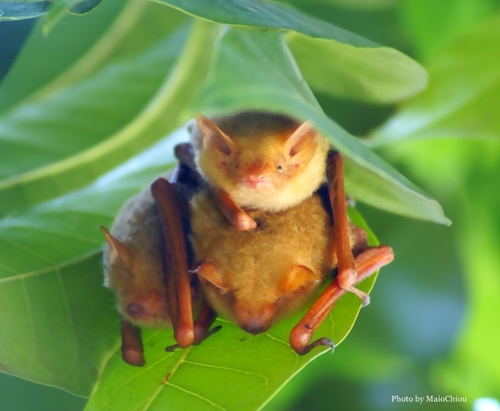
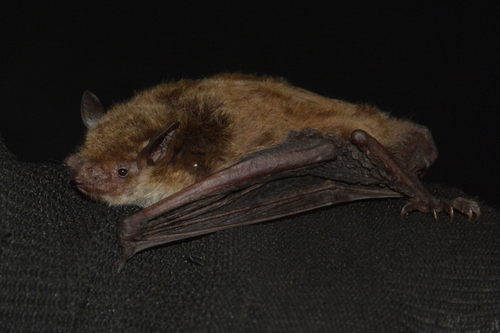
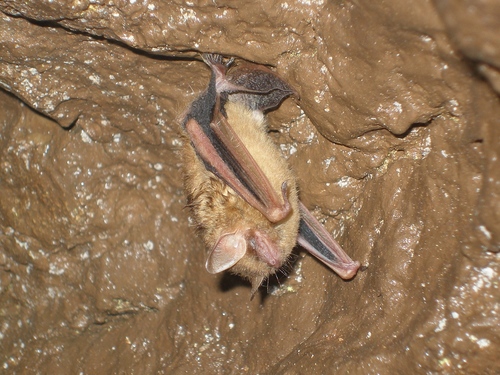
This species, commonly called the tricolored bat, has the scientific name Perimyotis subflavus (F. Cuvier, 1832). The tricolored bat has blond fur that is distinctly tricolored along its back. Each individual hair has three color segments: dark gray at the base, yellowish brown (buffy) in the middle, and brown or reddish brown at the tip. It is the smallest bat species found in the eastern and midwestern United States. Individual bats have a forearm length of 31.4–34.1 mm (1.24–1.34 in), weigh 4.6–7.9 g (0.16–0.28 oz), and have a wingspan of 21–26 cm (8.3–10.2 in). Its forearms are reddish, which contrasts sharply with the black membranes of its wings. It has a dental formula of 2.1.2.3/3.1.2.3, giving it a total of 34 teeth. The tricolored bat is common across eastern North America; the southern end of its range reaches Central America, and the northern end reaches southern Canada. Since the 1980s, its range has expanded westward, now including the U.S. states of Colorado, New Mexico, South Dakota, and Wyoming, as well as the Great Lakes Basin. The tricolored bat is a seasonal breeder; mating (copulation) occurs in the fall before hibernation. Ovulation does not happen until spring, and females store male sperm in their uteruses over the winter. Gestation (pregnancy) lasts approximately 44 days, and females give birth in June or July. Litter size is most often two pups. At birth, the combined mass of twin pups can be as much as 58% of the mother's postpartum mass. Newborn tricolored bats have no fur, and their eyes are closed. While the mother forages for food at night, she leaves her offspring behind at the roost. Young bats develop quickly: they begin flying at three weeks old, and can forage on their own by four weeks old. Young bats do not reach sexual maturity in their first fall, and do not breed until their second fall. Wild tricolored bats can live at least 14.8 years. Juveniles have higher mortality rates than adults, and females have higher mortality rates than males.