About Perideridia gairdneri (Hook. & Arn.) Mathias
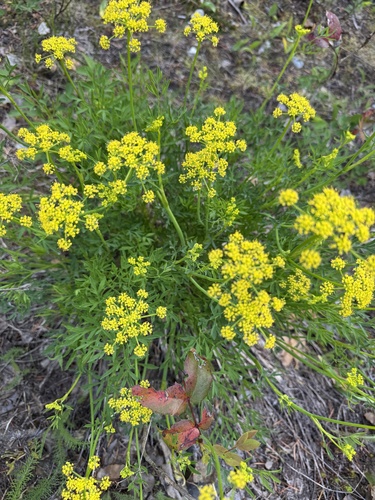
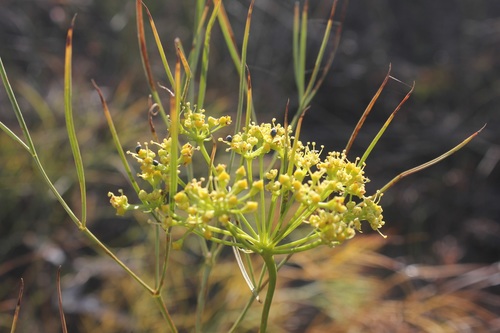
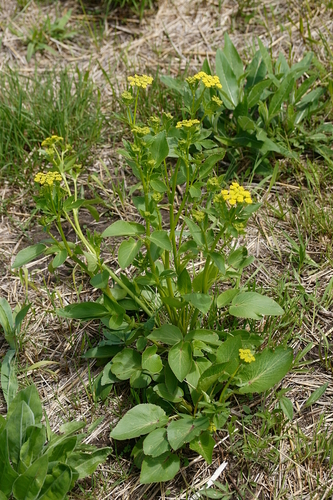
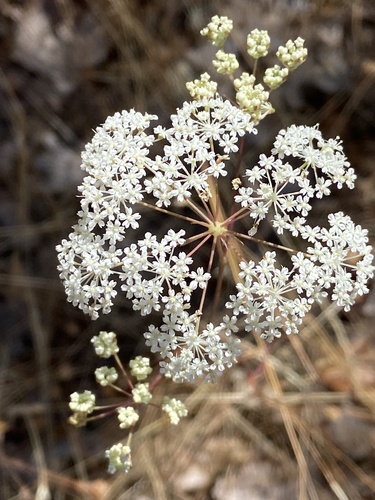
Perideridia gairdneri (Hook. & Arn.) Mathias is a flowering plant species in the Apiaceae family, commonly known as common yampah, Gardner's yampah, and Squaw root. It is native to western North America, ranging from southwestern Canada through California to New Mexico, and it grows in a wide variety of habitat types. This is a perennial herb that reaches 0.6 to 1 meter (2.0 to 3.3 feet) in height. Its slender, erect stem grows from cylindrical tubers that can measure up to 8 centimeters long. Basal leaves have leaf blades up to 35 centimeters long, divided into many narrow, further subdivided lobes. Leaves located higher on the stem are smaller and less divided. The plant's inflorescence is a compound umbel made up of many spherical clusters of tiny white flowers. After flowering, it produces ribbed, rounded fruits that are each a few millimeters long. The entire plant is edible, but foragers must use caution, as it closely resembles two deadly members of the carrot family: water hemlock and poison hemlock. This plant was an important, even staple, food source for many Native American groups, including the Blackfoot, Northern Paiute, Cheyenne, and Comanche. The common name yampa likely derives from the Comanche name for the plant's tuber, which is recorded as both yap and yampa. A major division of the Comanche people, the Yapainuu, translates to "yap eaters"; this group is more commonly called the Yamparikas, and they roamed what is now northern Oklahoma in historic times. Their well-known chief was the famous Ten Bears. The plant's tuberous roots can be prepared and consumed like potatoes: they may be roasted, steamed, eaten fresh, or dried, and they can also be made into mush or pinole, ground into flour, or used as a flavoring. The tubers were also used for medicinal purposes. Meriwether Lewis encountered this plant in 1805 and 1806, identifying it as a species of fennel. This edible root has different Indigenous names across various languages: it is called cawíitx in Nez Perce, sawítk in Sahaptin, yap in Comanche, and nits-ik-opa (meaning "double root") in Blackfoot. Pacific Northwest tribes know the root by the names yampa, ipo, or sa'-hweet.