About Pericrocotus igneus Blyth, 1846
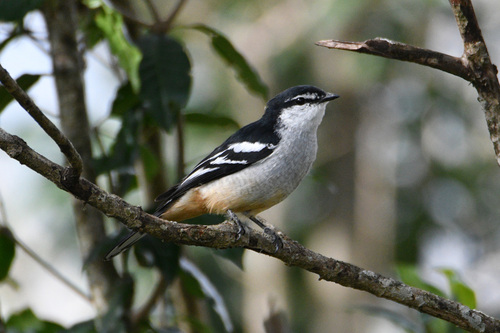
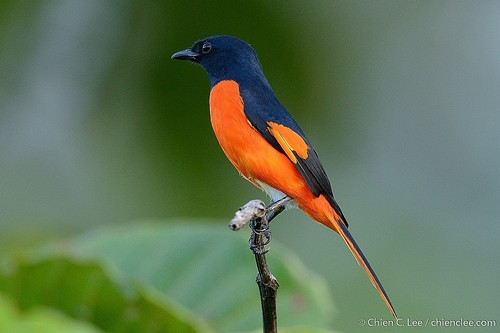
The fiery minivet (Pericrocotus igneus Blyth, 1846) measures 15–16.5 cm (5.9–6.5 in) in length and displays sexual dimorphism. Males have a glossy black head and mantle, an orange-red back, and mostly glossy black wings. Males' secondary coverts have orange-red edges, with an orange-red patch present on the flight feathers. The gradated tail of the male is black and orange-red. Males have a glossy black chin and throat, with all other underparts colored orange-red. Their eyes are dark brown, while their beak and feet are black. Females have a grey head, with orange lores and orange eye-rims. A female's back is lead grey, and her rump is orange-red. Female wings are darker grey, and the female's wing patch is paler than the male's. Female underparts are yellow. Juvenile fiery minivets have sooty brown upperparts and sooty black flight feathers. Juveniles have off-white underparts from the chin to the upper belly, with the remaining underparts colored pale yellow. After a post-juvenile moult, young birds develop a plumage similar to that of adult females. This species is distributed in Tenasserim, the Thai-Malay Peninsula, Sumatra and its satellite islands, Borneo, and Palawan. It is currently locally extinct in Singapore. The fiery minivet inhabits the canopy of lowland broadleaf forest, as well as forest edges, peat swamp forest, well-grown secondary forest, coastal forest, and mangrove forest. It occurs at elevations up to 1,200 m (3,900 ft), and is found mainly below 600 m (2,000 ft). It occasionally visits wooded gardens located near forests.