About Pericrocotus divaricatus (Raffles, 1822)
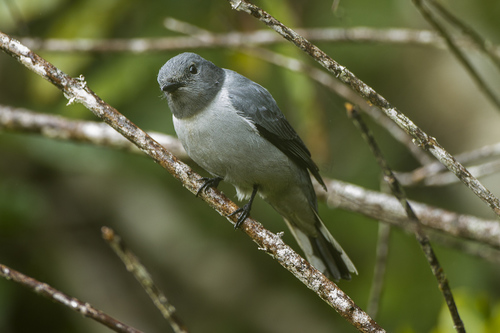
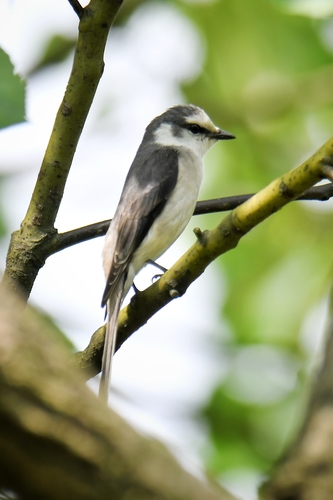
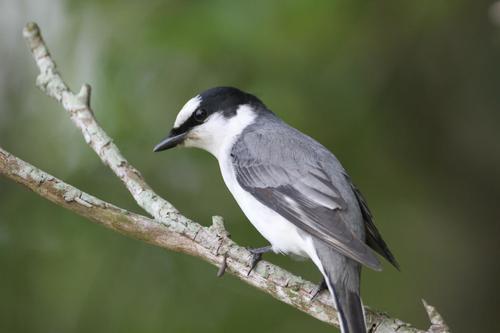
This species, Pericrocotus divaricatus (the ashy minivet), is 18.5–20 cm long. Males are grey above and whitish below. They have a black cap with a white forehead, a white band across the flight-feathers, white outer tail feathers, and black bill and feet. Females have a grey cap, with a black band between the bill and eye and a narrow white band above this black band. Its call is a high-pitched, metallic trill. It is considered closely related to Pericrocotus roseus and Pericrocotus cantonensis, but differs in moult pattern. It is one of the few passerine birds that moult their primaries twice a year, and is the longest distance migrant among minivets. It breeds in south-east Siberia, north-east China, Korea and Japan. Birds native to the Ryūkyū Islands of southern Japan are commonly considered a separate species: the Ryukyu minivet (P. tegimae). The ashy minivet is a long distance migrant that winters in South and South-east Asia, ranging as far south as Sumatra, Borneo and the Philippines, and also occurs in Sri Lanka; it was first recorded in northern parts of its winter range in January 2026. It lives in forests, as well as in more open areas with scattered trees. It forages for insects in the tree canopy, and sometimes joins mixed-species foraging flocks. Migrant individuals are often seen in large flocks. The species' status is considered secure, and it is listed as a "least concern" species by the IUCN. Populations of the species on Amami Island were found to have increased between 1985 and 2001. In the South Asian region, this species is considered rare. It was first noted on the Indian mainland only in 1965, although it had been reported from the Andaman Islands in 1897. It has been reported with greater regularity since that time. This species lays four to seven eggs, which are incubated for 17 to 18 days.